Nexstrom, a Singapore-based chip equipment start-up, has raised a $12 million seed round to commercialise a system it says can manufacture a promising class of next-generation semiconductor material at industrial scale.
The company is targeting transition-metal dichalcogenides, a family of so-called 2D materials that are only a few atoms thick.
Such materials are seen as a leading candidate to succeed silicon, whose performance is starting to falter as chipmakers shrink transistors towards the atomic scale.
Because they stay stable and conduct electricity well even when a single layer of atoms thick, 2D materials could let chips keep getting smaller, faster and more energy efficient.
The catch is manufacturing, as researchers can grow tiny, high-quality flakes in the lab but not the large, uniform sheets that commercial factories need.
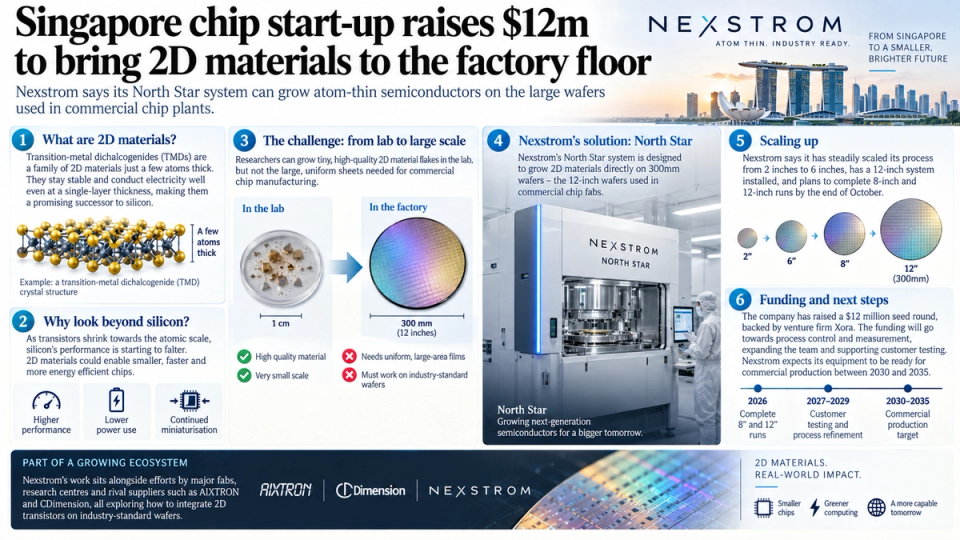
"In the lab, people can get very small, high-quality materials, but only on a very small scale," said Lance Li, co-founder and chief scientist.
Nexstrom's system, called North Star, is designed to grow the material directly on the 300mm wafers, about 12 inches across, that are standard in the plants where chips are made, known as fabs.
The company, incubated by the venture firm Xora, is pitching the equipment to the foundries that manufacture chips for others, positioning itself as a supplier rather than a competitor.
It says it has steadily scaled its process from 2 inches to 6 inches, has a 12-inch system installed, and plans to complete 8-inch and 12-inch runs by the end of October.
Nexstrom's effort sits alongside work by large fabs, research centres and rival suppliers such as AIXTRON and CDimension, all exploring how to integrate 2D transistors on industry-standard wafers.
The company said the funding would go towards improving process control and measurement, expanding its team and supporting customer testing, and it expects its equipment to be ready for commercial production between 2030 and 2035.