In the 2011 film Too Big to Fail, William Hurt plays a thwarted Hank Paulson, the US Treasury Secretary. In one scene, he drops to one knee to beg House Speaker Nancy Pelosi to sign off on a $700 billion rescue deal after the collapse of Lehman Brothers.
This, you might think, is Hollywood’s spin. Except it was reported in The New York Times, citing people very, very close to those discussions.
I mention this not as a note of nostalgia, but to illustrate a point. In times of crisis, do not turn to feuding politicians. Grasp of reality tends to be lacking, while tribal feuds and who claims the glory may scupper a rescue.
This week the script was flipped.
No kings
A king in the country of no kings rode to the rescue of the AI trade, and in doing so averted a crisis some believe would dwarf the Great Financial Crisis of 2008. Or so the narrative goes.
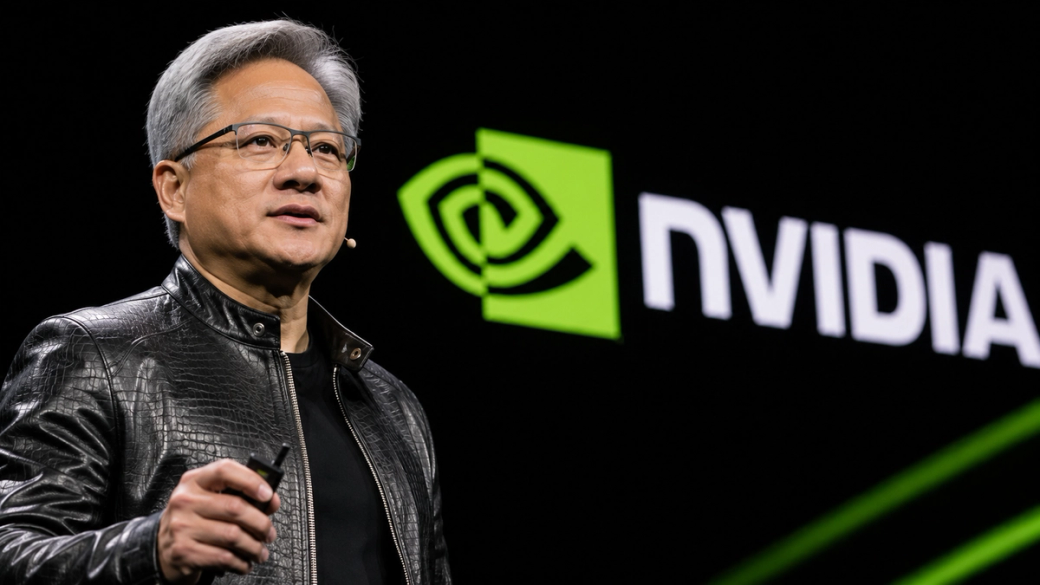
He did so by circumventing naysaying politicians (and national and corporate governance) to reinstall Jensen Huang, one of his princelings, in his rightful seat at the head of Nvidia.
Historians may well look back at this action and see it as a masterstroke that shored up confidence in America’s overweight tech sector by rebalancing the Jenga blocks that hold it up.
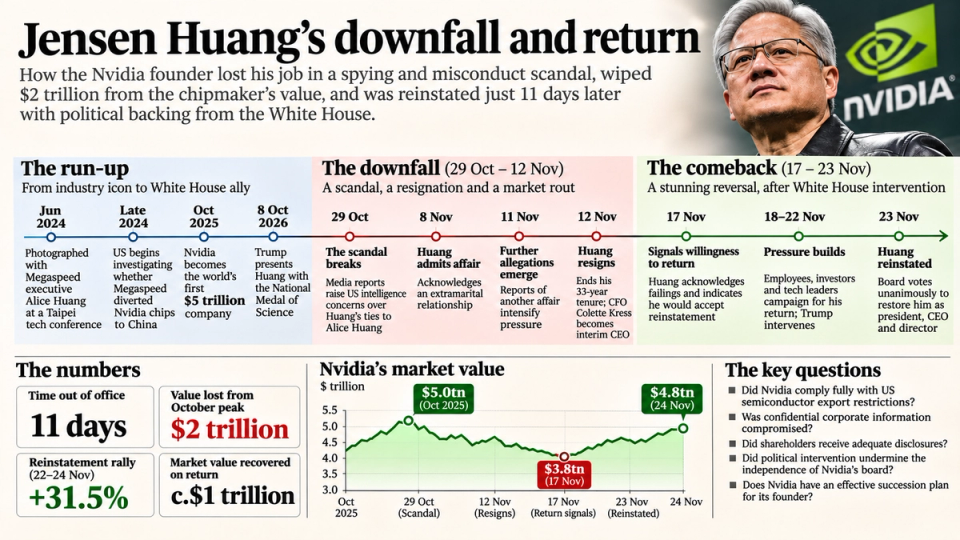
Certainly, the markets on Monday climbed higher on the nitrous-oxide hit of euphoria. Nvidia reclaimed 30% of its value, or almost $1 trillion in market value, which in effect tells you how Wall Street gauges Huang’s worth.
Analysts scrambled to upgrade the stock. “Jensen’s return is a win for AI and a win for investors,” said Oppenheimer’s Rick Schafer. Steve Sosnick of Interactive Brokers, in a nod to Paulson, said Huang was “too big to be fired”.
The hangover
By Tuesday the gas was wearing off. Nvidia shares fell almost 6% and even the bulls were hedging.
Bernstein’s Stacy Rasgon upgraded the stock but described the board’s on-again, off-again handling as “clown-like”. Dan Ives of Yorkville reckons the shares are worth $300 with Huang back. He still won’t lift his $225 target until the board’s investigation is resolved.
And you can see why the nerves are jangling. Last week, Nvidia’s chair told investors Huang would not be coming back. Eleven days after he resigned, he was back anyway, before any of the investigations into his conduct had concluded.
“The board has reached its verdict before the evidence is in,” said Nada Kakabadse of Henley Business School. Charles Elson of the University of Delaware called it “a lack of courage”. Columbia’s Shiva Rajgopal offered the directors a kinder way out: he doubts any board could have said no to the president.
Washington is not cheering either, and that includes Trump’s own party. “You gotta be kidding me,” was Senator John Cornyn’s response. Fellow Republican John Curtis wants to know who in government weighed in, and what they told the board. Kevin Cramer said the risk of extortion alone was reason enough not to rehire Huang.
Read more about Chipmakers
- 23/11/26Trump said he 'personally convinced' Nvidia to reinstate Jensen Huang
- 23/11/26Nvidia adds almost $1 trillion as Jensen Huang returns to the helm
- 11/11/26The $2.1 trillion question facing Nvidia's board as it investigates Jensen Huang
Jan van Eck, a large Nvidia investor, summed up the gamble. The administration, he said, is willing to risk that “there are no more bad facts to emerge”.
Unsackable
But what precedent does it set? It essentially tells the other members of the trillion-dollar club that they are “unsackable”, without ever even having to pull the Trump card from their top pocket. Bloomberg’s editorial board said the intervention “sets a dangerous precedent”. Republican congressman Pat Harrigan said it sends a signal that “one man’s financial impact on our economy outweighs the importance of good governance”.
It means the lords of Silicon Valley can rule unfettered and run roughshod over the checks and balances meant to ensure they are working in the best interests of shareholders. New York City’s comptroller, Mark Levine, oversees pension funds holding about five million Nvidia shares. His verdict on the board: “They have proven they’re not independent.”
For the AI companies, this has an added dimension.
People such as Anthropic’s Dario Amodei and OpenAI’s Sam Altman (and to a lesser extent the other tech bros) have wider responsibilities to humanity.
Growing reports of recursive self-improvement, where the model optimises exponentially without human input, are truly scary.
And it is against this backdrop that we are giving AI’s ruling elite a free pass to do what they want, while we are left hoping they will act for the greater good.
This article first appeared on Medium