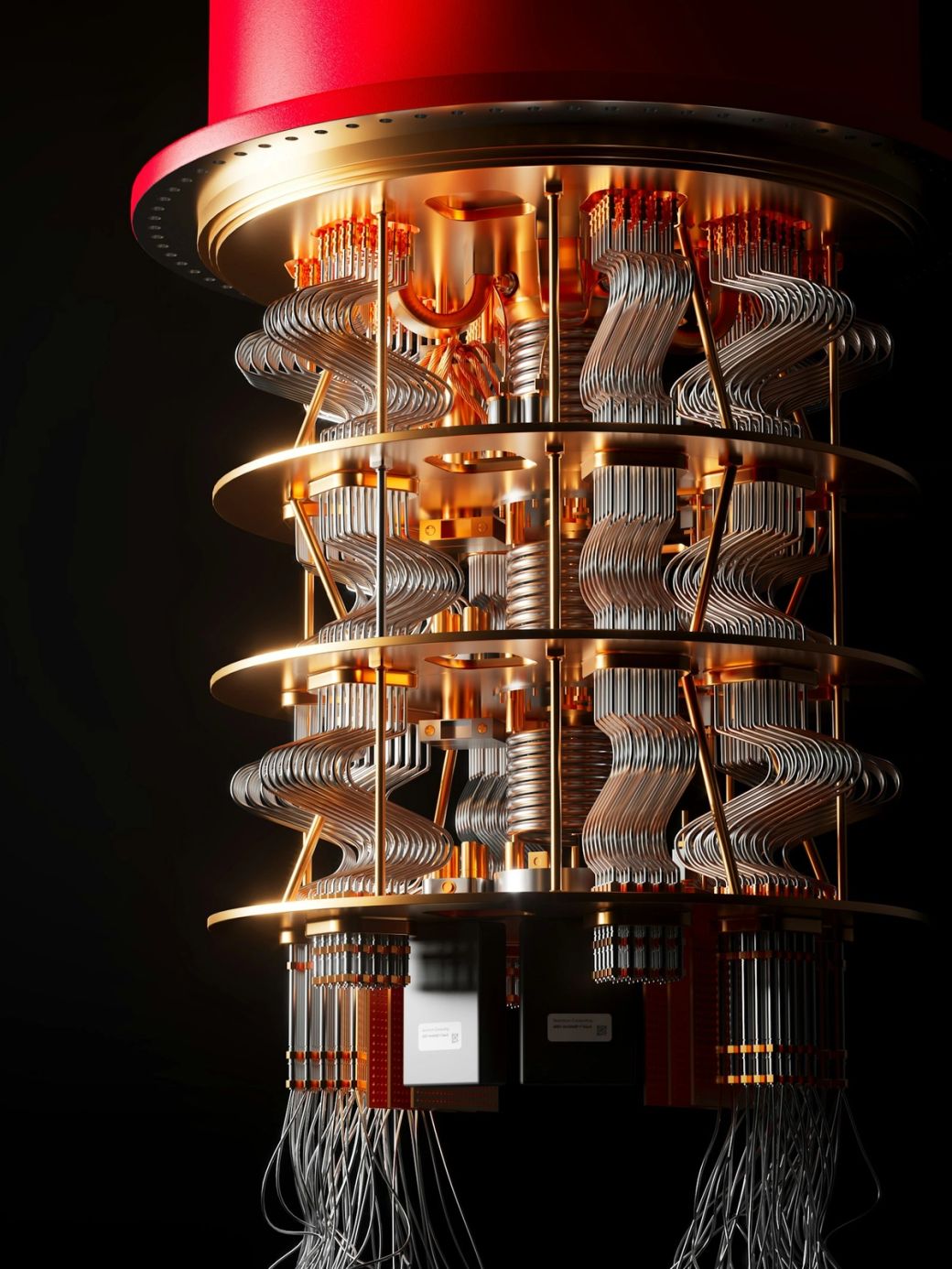
The most interesting thing at this year's Quantum World Congress was the software helping build the machines.... not a qubit count.
Microsoft showed agentic workflows that turn plain-language prompts into quantum circuits and then run them. Infleqtion, the self-proclaimed leaders in the technology, said AI had found a gate that halved its physical gate count.
QuEra, which computes using neuron atoms, described an Anthropic Claude agent automating laser calibration. It also highlighted NVIDIA's transformer-based error decoding.
Matt Bryson at Wedbush Securities spent the week at the event in College Park, Maryland. He rates this convergence of AI and quantum research a "strong green flag".
In providing the signal, he points to gains in hardware, error correction, software and AI are starting to compound. The result is that timelines keep moving closer.
Debate shifts from whether to when
Fault tolerance is the point at which a quantum computer can correct its own errors well enough to run long, reliable calculations. This, of course, is key to real commercial work.
Bryson says the main-stage conversation has moved on from whether it arrives. The talk now is about timing and method.
For example, IonQ is targeting 800 logical qubits in 2027. Quantinuum aims for about 100 with its Sol system in the same year. QuEra plans a 256 logical qubit fault-tolerant machine in 2028.
Silicon Valley analysts have pencilled in 2030 for the advent of quantum computation with real commercial value. Bryson's conversations at the event suggest it could come sooner.
Speakers pointed to molecular simulation and optimisation as the likely first uses that make money.
Neutral atoms gather momentum
One hardware approach stood out, according to those at the gathering. Neutral atom platforms, which hold individual atoms in place with lasers, appear to have real momentum in Bryson's view.
Infleqtion demonstrated 30 logical qubits on 80 physical qubits using its commercial Sqale system. For the unitiated, this meets its 2026 target and supports its plan for 100 logical qubits in 2028. Bryson wants the full paper and its fidelity data before going further.
Private company QuEra made the biggest impression. Bryson ranked it among the most information-rich presenters at the event.
Management expressed confidence in demonstrating fault tolerance in late 2027 or early 2028, ahead of consensus. Bryson names QuEra as the private quantum company investors should get to know over the next year or two.
Revenue generation
There is a catch that Bryson in a note following the event flags amber. Most milestones vendors discuss are demonstrations. Turning them into production work for paying customers is harder to date.
The next wave of machines is still some way off. IonQ's Superion 256, QuEra's Libra and the Magne system from Microsoft and Atom Computing are slated for delivery in 2027 and 2028.
That suggests, meaningful revenue is unlikely to occur in the next 18 months.
Washington and Maryland lean in
The Commerce Department has finalised $100 million CHIPS awards for D-Wave, Rigetti and Quantinuum.
Maryland Governor Wes Moore used the event to pitch his state as a national quantum hub, with an unashamed pro-business message.
How the listed names fared
IonQ (IONQ) drew one of the most packed rooms of the week, according to attendees. It lined up Superion 256 deployments at NVIDIA's Accelerated Quantum Research Center, Florida International University and Korea's SDT. It also demonstrated real-time error decoding.
Infleqtion (INFQ) gets a green flag from the Wedbush analyst for hitting its 2026 logical qubit target.
D-Wave (QBTS) restated its dual-platform plan. It pairs production annealing results with a dual-rail gate-model roadmap, now backed by its CHIPS award, and pointed to public sector momentum.
Rigetti (RGTI) chief executive Subodh Kulkarni set out a strategy built on chiplet-based scaling and execution. It is supported by a C-DAC system due for deployment in the second half of 2026.
Quantum Computing Inc (QUBT) presented its photonics commercialisation plan. Bryson came away without any major roadmap updates, so his view is unchanged.
Bryson's firm does, and seeks to do, business with companies covered in its research, and acknowledges this could affect the objectivity of its reports.