
It would be easy to read Monzo's sale talks with Nubank, Latin America's largest digital bank, as a sign that investors have given up on fintech.
The numbers point somewhere else: Monzo is worth different amounts to different owners, and a Brazilian bank may be the one that can get the most from it.
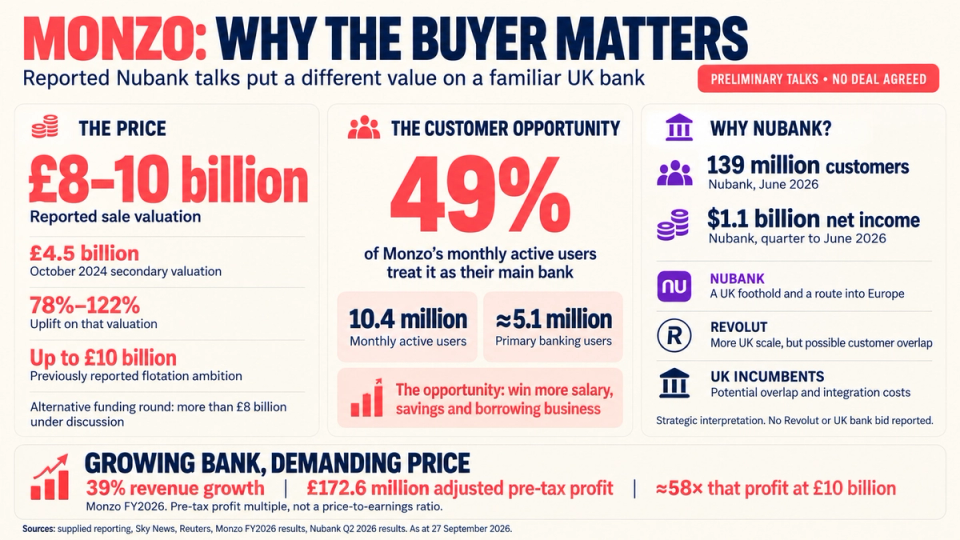
Sky News reported at the weekend that Nubank is in early talks over a deal valuing Monzo at between £8 billion and £10 billion.
Monzo's board is also looking at a funding round at more than £8 billion to pay for expansion into mainland Europe.
A success that falls short
For Monzo's investors, the price is a win and a disappointment at the same time.
It would be 78% to 122% above the £4.5 billion valuation set by an employee share sale in October 2024.
At the top of the range, it would do no more than match the £10 billion flotation valuation bankers were discussing a year ago.
At £8 billion, shareholders would accept less than that ambition in return for the certainty of a deal.
The more relevant benchmark is the alternative funding round, which a £10 billion sale would beat by less than 25%.
The two prices also measure different things.
A funding round prices a minority stake, often with protections for new investors, while a takeover prices control of the whole business.
What Nubank is buying
The obvious question is why Nubank would pay up to £10 billion for a bank with modest profits.
Monzo made a statutory pre-tax profit of £87.3 million in the year to March, or £172.6 million after stripping out a regulatory fine and restructuring costs.
At £10 billion, that is about 58 times adjusted profit and 115 times the statutory figure.
Nubank would be paying for a new market and for what it thinks it can earn from Monzo's customers.
The São Paulo bank made net income of $1.1 billion in the three months to June and has 139 million customers, almost all in Latin America.
It has little presence in Europe beyond a technology office in Berlin.
Monzo would bring a UK banking licence, a known brand, a European licence and a planned launch in Spain.
That would save Nubank years of building from scratch.
It would also reverse the usual pattern, with a digital bank from an emerging market buying one of Britain's best-known challenger banks.
The 49% figure
The most telling Monzo number is 49%.
That is the share of its 10.4 million monthly active users who treat it as their main bank, about 5.1 million people.
Those customers bring salaries, savings and borrowing, which is where a bank earns its money.
The other half are the opportunity: people who use a Monzo card but keep their main account elsewhere.
Nubank has built its business on getting customers to move more of their finances to it.
Its bet would be that it can do the same with Monzo's users faster than Monzo can alone.
Why Revolut looks different
No talks with Revolut have been reported, but Monzo's larger rival shows how the same asset changes value with the buyer.
Revolut began an employee share sale in July at $115 billion, almost nine times the top of the Monzo range.
Monzo would give Revolut deeper UK relationships and £25.7 billion of deposits.
But many of those customers may already use Revolut, so part of the price would buy customers it has.
Revolut would be buying scale in a market it knows, while Nubank would be buying its way into a new one.
Why no UK bank has bid
The same logic explains the absence of a high-street bidder.
A UK lender would pay a high multiple of current profits for customers who, in many cases, already bank with it.
It would add to its exposure to one market rather than spread it.
It would then have to choose between leaving Monzo alone, which limits cost savings, and absorbing it, which risks the brand customers chose.
A board would weigh all that against buybacks, dividends, smaller deals and spending on its own apps.
What it says about fintech
The UK funding picture is weak, with KPMG putting fintech investment at £1.8 billion in the first half of 2026, down from £5 billion a year earlier.
Global fintech investment rose to $103.1 billion over the same period.
Revolut and Stripe, valued at $159 billion in an employee share sale in February, show investors still pay high prices for financial businesses with international reach.
What has changed is where the biggest valuations sit.
Anthropic, the artificial intelligence (AI) developer, raised $65 billion in May at a $965 billion valuation.
Harvey, a legal AI start-up, raised $550 million this month at a $15.5 billion valuation, more than the price under discussion for Monzo.
Monzo is being priced as a growing bank whose opportunity can be measured, while AI companies are priced as possible global platforms.
Neither guarantees the better return, since fast growth bought at too high a price can disappoint.
Monzo grew revenue by 39% last year, so it has not stopped growing.
The sale looks more like a fintech investment reaching maturity than a sector falling out of favour.
What the backers do next
For early investors, a sale would end a long wait for an exit.
They must weigh a price now against the cost and risk of chasing a higher one, which would mean more funding and a European expansion to pay for.
It is tempting to assume the gains will flow into AI.
Venture funds usually return exit proceeds to their own investors, who then decide whether to back new funds.
A deal paid partly in Nubank shares would also leave some Monzo investors holding a bank rather than cash.
What London loses
A sale would take one of the larger names out of London's flotation pipeline.
Monzo had been preparing a listing with Morgan Stanley, with a £6 billion to £7 billion target for much of this year.
But it had also looked at New York, so London was never guaranteed the listing.
The question to watch is what Nubank thinks it can earn from Monzo's customers that Monzo cannot yet earn itself.