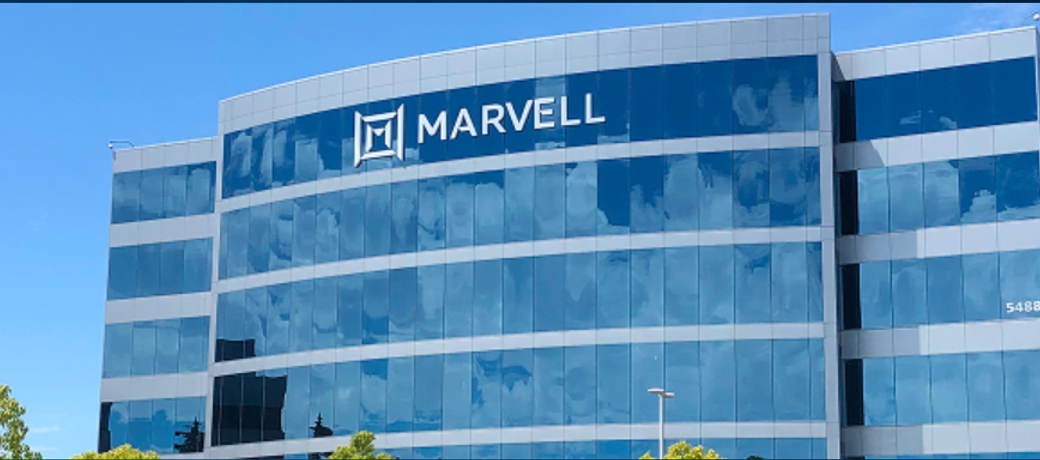
Marvell Technology's shares have tripled in 2026 and jumped a further 18% on Tuesday after the company raised its long-term revenue forecasts by a margin that left Wall Street's estimates looking like rough guesses.
But unlike Nvidia, whose chips have become almost synonymous with artificial intelligence, Marvell has no consumer product, no household name and no logo most people would recognise.
So what does it actually do?
The chip market has layers
Nvidia dominates the layer most people know about: general-purpose graphics processing units (GPUs) that power AI model training.
Beneath that sits a different market, built around the growing desire of the world's biggest technology companies to stop relying on a single supplier for the chips running their data centres.

Google, Amazon and Microsoft have all been investing heavily in designing their own AI processors, built around their specific software and optimised for their specific power and cost requirements.
The problem is that designing a chip from scratch requires deep specialist expertise most technology companies do not have in-house.
That is where Marvell comes in.
Custom silicon
Marvell's business is custom silicon: it takes a hyperscaler's requirements and engineers a chip to match them precisely, working with specialist manufacturers to produce it at scale.
The arrangement suits both sides.
The hyperscaler gets hardware tuned exactly to its workload, which is more efficient and cheaper at scale than buying off-the-shelf components.
Marvell gets a long-term supply relationship with a customer that has almost unlimited spending power and very high switching costs, because once a data centre is built around a custom chip, changing suppliers is an enormous undertaking.
Where it sits
Marvell's closest rival is Broadcom, which operates a similar model and whose shares rose around 4% in sympathy on Tuesday.
Together they occupy a layer of the AI infrastructure market that is less visible than Nvidia but increasingly critical.
Marvell's deal with Google, disclosed in August, could generate up to $120 billion in revenue through fiscal 2033 if performance milestones are achieved.
On Tuesday the company forecast fiscal 2031 revenue of $70 billion to $90 billion, against a Wall Street consensus of $46.85 billion.
Why it matters
The broader significance is what Marvell's position reveals about where the AI industry is heading.
The hyperscalers are quietly building an alternative chip layer beneath Nvidia, one supply contract at a time, and the companies helping them do it are becoming very large businesses very quickly.
Tuesday's numbers suggest that process is moving faster than the market had assumed, which is why a forecast upgrade at an investor day sent a $250 billion company up nearly a fifth in a single session.