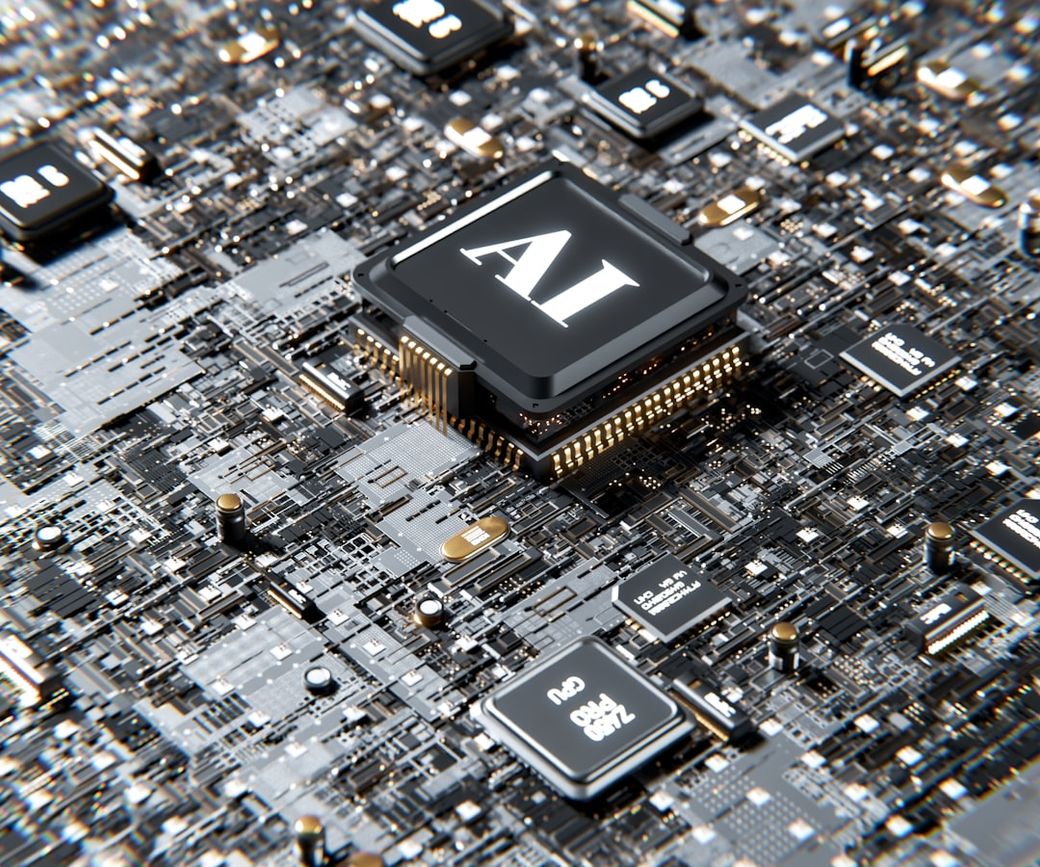
Building a TPU is only worth it at scale. Google's Tensor Processing Units were designed for internal use, which meant the economics depended entirely on Google's own workloads to justify the manufacturing run with Broadcom.
Selling externally changes that maths. It means, every chip Anthropic buys spreads Google's fixed costs further and strengthens the case for the next production cycle.
Anthropic is one of the few buyer capable of absorbing the volume at the scale Google needs, fast enough for the process to be meaningful for all involved.
How the money moves
This is a an AI version of 'follow the queen', which also involves chipmaker Broadcom and some of America's biggest financial institutions.
The hardware itself is funded through a form of vendor financing built around a special purpose vehicle called Compute SPV.
In this set-up, Broadcom buys the chips from Google, then sells them on to Compute SPV.
In June, Compute SPV paid $35 billion for an initial tranche of roughly one million chips, which together require a gigawatt of power to run.
This was financed by private credit firms including Apollo and Blackstone.
The chips are now being installed in American data centres that Google has helped to build.
More to come
Google has committed to selling Broadcom a further $128 billion of TPUs over the coming years.
Future batches are expected to move through the same financing structure before being leased to Anthropic.
Google is still working to secure enough data centre capacity and electricity supply to keep the chips running.
An unusual arrangement
The structure means Google is underwriting the expansion of a company it competes with in the AI race, while also profiting from the hardware sales that make that expansion possible.
For lenders and chipmakers, the arrangement offers a way to finance a customer with no balance sheet of its own.
For Google, it offers a route to challenge Nvidia's dominance without waiting for Anthropic to raise the capital independently.
No chip challenger beats Nvidia by selling to one internal teams
Google needs proof that TPUs work for someone else, under commercial pressure, at genuine scale.
Anthropic cannot offer that proof without help. It has no credit rating, no data centres and nothing like the capital required, which is precisely why Google stepped in to guarantee the leases and engineer the financing.
But don't be fooled, this is Silicon Valley, so this is not charity. Put simply, Google underwriting the a reference customer that can make TPUs look like a viable alternative to Nvidia's hardware, rather than a Google-only curiosity.
So, this is a hedge, not a gift
Google already holds a substantial stake in Anthropic. Every dollar of infrastructure that expands Anthropic's capacity also expands the value of that stake, regardless of which cloud or chip actually powers the workload.
Financing the expansion through TPU sales means Google captures value twice: once as an investor benefiting from Anthropic's growth, and once as a hardware supplier earning margin on the chips that growth requires.
Nvidia gets neither of those upsides from an Anthropic contract. Google does, which is why it is willing to carry risk that would look reckless for any lender without equity in the outcome.
Should Nvidia be nervous?
Nvidia's dominance rests on being the default choice, not necessarily the best one. Anthropic operating at gigawatt scale on TPUs, backed by Google's balance sheet, gives every other AI lab a working example of life without Nvidia's chips.
This a riff on JK Galbraith's maxim that capital fills a void (with an AI twist, of course). In reality, Google's move is the difference between a threat on paper and a competitor with a live reference customer. Anthropic is effectively testing workloads and there's a Google-shaped safety net underneath the whole arrangement.
If Anthropic delivers at the scale this financing implies, Nvidia is not just facing a rival chip. It is facing proof that its moat was narrower than its market share suggested.
Buckle up. This is going to be interesting, if a little mind-bending.