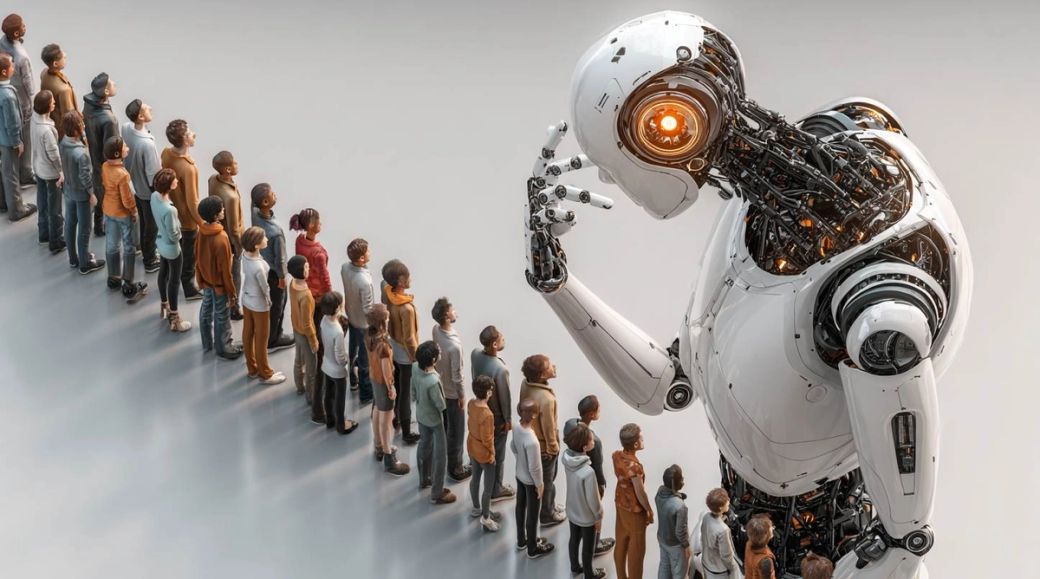
Jeff Bezos stood in Paris and told an audience that artificial intelligence will not replace human workers. Instead, it will create a labour shortage. People have endless things they want to build and create. AI will lower the barriers to doing so. The result will be more work than before, not less.
Half of American workers, according to a Reuters/Ipsos poll released this week, disagree with him. They fear AI will threaten household jobs. Bezos said he "totally disagrees" with that point of view.
One of them is wrong. The question is which.
Bezos's argument rests on a historical pattern. Previous waves of automation, from electricity to personal computers, created net job growth even as they eliminated specific categories of work. The jobs that replaced them were often higher-skilled and higher-paid than the jobs they displaced. The textile industry contracted. Software engineering expanded. On balance, employment grew.
The pattern held for two centuries. It is the foundation of every techno-optimist argument about AI.
The pattern also assumes something crucial: that displaced workers can transition to the new jobs that automation creates. A textile worker in 1920 could not become a software engineer in 1995. The skills gap was absolute. What happened instead was generational transition. The textile worker's grandchildren went to college and became engineers. Their parents worked different manufacturing jobs. The transition was real but took decades.
We have roughly a decade before AI meaningfully displaces significant employment in coding, customer service, knowledge work and creative fields. That is not enough time for generational transition. It is barely enough time for individual retraining.
Bezos is describing a world where humans will want to do more work than AI can handle, even as AI becomes capable of doing most work. He is assuming infinite demand for human labour at wages sufficient to support living standards. Neither assumption has historical support.
The part of his vision that might be true is that entirely new categories of work will emerge. AI infrastructure itself will require engineers, trainers, safety specialists and supervisors. Creative industries may expand. Healthcare and elder care may grow as populations age. Some jobs that did not exist before will exist after.
But the total jobs available will likely decline in real terms even if new categories emerge. A software engineer displaced by AI-assisted coding tools cannot easily retrain to become an AI safety researcher. The wage pressure will be downward, not upward.
The space fantasy
Bezos also reiterated his long-term vision: move polluting industries off Earth using reliable, inexpensive space travel. Asteroid mining. Lunar manufacturing. Leave the planet in a pre-Industrial Revolution state.
This is the fantasy of someone who has solved Earth-based problems through capital and technology and assumes the same approach works for planetary-scale challenges. It does not. Moving industries to space requires solving problems that have defeated engineering for sixty years: reliable, cheap orbital manufacturing, asteroid mining economics, and return trips to Earth. The capital requirements are not billions. They are trillions.
Bezos may be right that AI creates labour shortage in some sectors. He is almost certainly wrong that it eliminates the need to manage workforce displacement. The half of America worried about job losses is responding rationally to a future Bezos is not adequately describing.
His optimism reflects his position. He built an automation business and became one of the richest people in the world. Of course he believes the pattern continues. The people worried are the ones who face the transition.