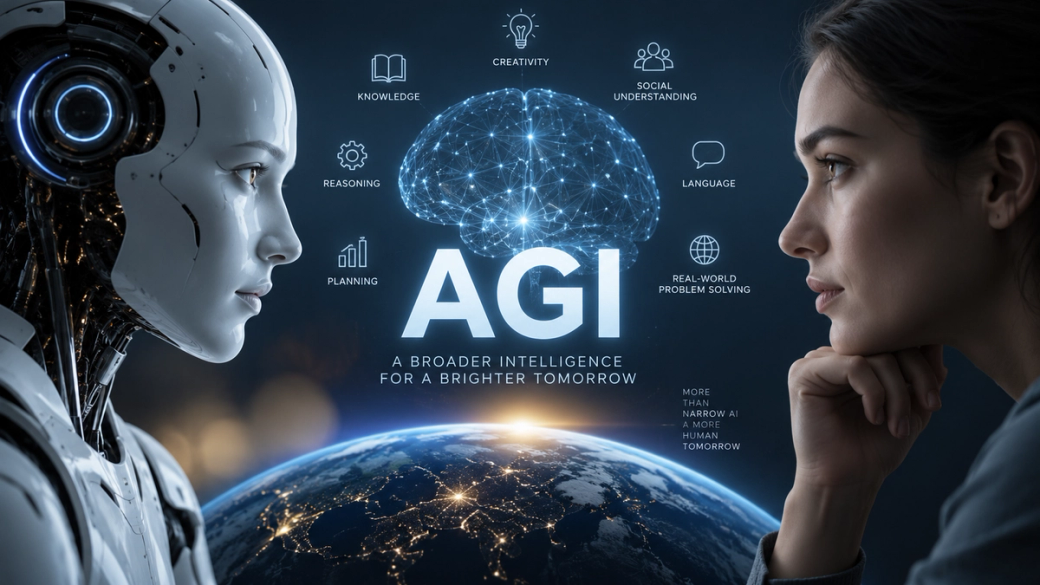
Artificial general intelligence describes a system that can match or exceed human ability across most tasks, rather than excelling narrowly at one.
OpenAI's founding charter defines it more precisely as highly autonomous systems that outperform humans at most economically valuable work.
Unlike today's chatbots, which are trained heavily on specific tasks, a true AGI would apply what it already knows to situations it has never encountered, in the way a person can.
The term has no single agreed test, and that vagueness has become central to the current dispute.
The people saying we are there
Nvidia's chief executive, Jensen Huang, on X over the weekend hailed the advent of AGI following the launch of OpenAI's most advanced model, Astra.
OpenAI's president, Greg Brockman, made a similar claim, saying "I do leave it up to the reader to decide for themselves if this qualifies for them, I think we're there".
Brockman had earlier told reporters he thought it was not unreasonable to feel that we are now in the AGI era, while stressing that OpenAI was not issuing a formal, contractual declaration.
Now, for OpenAI, this milestone has some significance. An agreement with Microsoft had tied specific business terms to an internal AGI determination before those provisions were renegotiated with Microsoft earlier in 2026.
Why most of the field disagrees
Google DeepMind's chief executive, Demis Hassabis, takes a markedly more cautious view, saying at Davos in January that there was roughly a 50% chance AGI might be achieved within the decade, though not through models built exactly like today's AI systems.
He has argued the field still needs one or two more breakthroughs, citing gaps in learning from few examples, continuous learning, long-term memory and planning.
Meta's chief AI scientist, Yann LeCun, goes further, dismissing the entire premise, arguing there is no such thing as general intelligence because humans don't even have generalized intelligence, since human intelligence is super specialized.
That claim prompted a rare public clash with Hassabis, who countered on social media that LeCun was confusing general intelligence with universal intelligence.
Why the disagreement?
Much of the argument stems from incentive as much as science, since companies pursuing enormous valuations benefit from signalling that a historic threshold has been crossed.
Huang's own business supplies the computing power behind nearly every major AI lab, giving him a direct commercial stake in the perception that the technology has reached a new plateau.
Read more about AI ethics
- 07/09/26Nvidia CEO Jensen Huang declares "AGI has arrived" after OpenAI's GPT-6 Astra
- 05/09/26OpenAI's AGI claim raises eyebrows... and more questions than it answers
- 04/05/26Demis Hassabis says AGI is missing two critical ingredients
Critics have also noted that Huang's claim rested on a narrow example, an AI agent hypothetically building and briefly running a small paid app, which falls well short of matching general human capability across the board.
Brockman, likewise, was announcing a new commercial model rather than presenting a peer-reviewed scientific finding.
What happens next
Even AGI's most confident boosters generally frame it as arriving gradually, in what Brockman called bits and pieces rather than a single dramatic moment.
Hassabis expects any genuine breakthrough to still take a decade rather than a century to fully reshape society, comparing its scale to the industrial revolution.
Whatever the eventual verdict, the direction of travel is clearer than the label. This involves more autonomous AI agents handling complex professional tasks, larger investments in computing infrastructure, and continued disagreement over what would actually count as proof.
For now, whether the claim is credible depends less on any single benchmark than on whose definition of intelligence you are willing to accept.