Netflix's third-quarter results, released after the close on Tuesday, were financially solid (on the surface, at least). Earnings per share of 87 cents beat the 82-cent consensus, up from 59 cents a year ago. Net income was $3.66 billion. Operating margin hit 34.6%, up more than six points from the same quarter last year and ahead of the roughly 33.2% estimate. Yet, the shares fell.
Wall Street saw through the window dressing
Revenue came in at $12.87 billion, up 11.8% year on year, essentially matching what analysts expected. But stand back and you realise growth was 16.2% in the first quarter, 13.4% in the second, and now 11.8%. That is the slowest rate of top-line expansion in three years, and investors noticed.
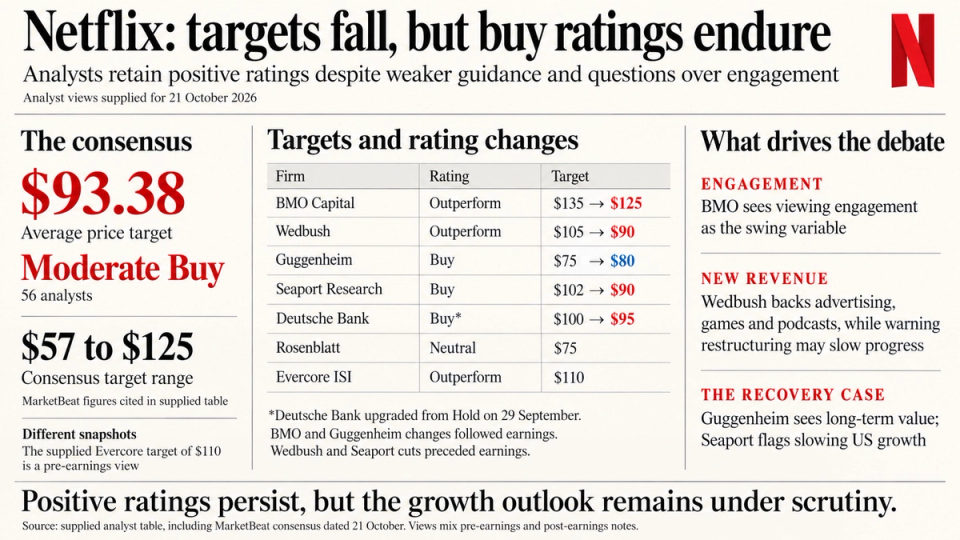
Netflix forecast fourth-quarter revenue of $13.44 billion, up around 12% year on year, but projected net income of $2.79 billion, or 67 cents per share. Analysts had been expecting $3.07 billion and 73 cents. So analysts will be downwardly adjusting.
The other miss was advertising. Netflix now expects full-year 2026 ad revenue of around $2.7 billion, down from the $3 billion it had previously forecast.
Co-CEO Greg Peters attributed the shortfall to delays in rolling out new ad products and partner integrations rather than waning demand.
The bull case: growth at reasonable(ish) prices?
A 34.6% operating margin is a serious number for a company that was earning 28.2% a year ago. Netflix is demonstrating that it can grow profit faster than revenue.
The record $4.8 billion share buyback in the quarter underscores that management is confident in the balance sheet and has no intention of chasing expensive acquisitions to paper over the growth question.
On advertising, the cut from $3 billion to $2.7 billion matters less, probably, than the trajectory. The ads business grew more than 80% in 2026. Peters insisted the delay in product rollout is a timing problem and Netflix plans to expand its ad-supported tier to 15 additional countries in 2027.
The addressable market for that business remains enormous, and the company's argument that its subscribers pay less per viewing hour than any comparable SVOD service gives it pricing headroom few rivals can claim.
The subscriber base is also still growing and Netflix has more than 325 million customers globally, and the company continues to add members through a combination of pricing discipline and a content.
While Netflix output has been inconsistent, it still produces enough breakout titles to justify the subscription.
Full-year 2026 revenue guidance of $51.1 billion represents 13% growth on 2025, and the company says it expects strong growth to continue into 2027.
Mark Mahaney at Evercore ISI, who carries an Outperform rating, viewed the Street's revenue estimate heading into the quarter as "reasonable to modestly conservative." The setup for bulls is that Netflix is becoming a cash machine; the question is whether the market will give credit for that before the growth numbers stabilise.
The bear case: engagement, competition and a strategy question
According to estimates by analysts at Jefferies, Netflix average monthly viewing time per member has fallen from 66 hours in the first half of 2023 to about 49 hours in the first half of 2026. This represents a 26% drop in engagement per user over three years, from a platform that charges its subscribers a subscription fee on the premise that they cannot get enough of it.
The competitive dynamic is shifting in ways that are difficult to price into the shares at this point. YouTube is said to have surpassed Netflix in average daily viewing in 2025. TikTok continues to compete for the same hours. Both are free to users.
Read more
- 18/07/26Netflix has run out of world to conquer, and no one is sure what comes next
- 17/07/26Netflix's problem is not the quarter, it is the script investors no longer believe
- 07/08/24Disney's waning theme park demand overshadowed first streaming profit
Add to the mix Warner Bros, which makes life infinitely more difficult.
Netflix had a deal to acquire Warner's studio and streaming assets late last year, then walked away in February. The failed pursuit of Warner Bros Discovery's streaming and studio assets earlier this year deepened doubts about Netflix's strategy.
Now, HBO Max and Paramount+ are now under the same roof, Skydance, after Paramount's $81 billion buyout of Warner Bros Discovery. In short, Netflix emerges a losers because the Warner Bros take-out creates a direct and well-capitalised rival with a combined content library that Netflix has no equivalent to. Walking away may have been fiscally prudent; it has left a long-lasting and painful hangover.
Netflix's stock has dropped 25% in 2026 amid broader industry consolidation, and the layoffs announced the week before earnings did not help sentiment.
Netflix is laying off 6% of its workforce, or roughly 1,000 employees, in its biggest cuts since 2022, targeting product, tech, legal and human resources teams. The official line is that the company is redirecting resources toward higher-growth areas. Gabelli Funds portfolio manager John Belton told the Associated Press that investors are worried about soft engagement trends and decelerating revenue growth.
In other words, with the company under pressure to find alternative revenue lines beyond subscriptions, lowering estimates for the ad business remains a concern.
The valuation problem
When Netflix reported, the shares were down 40% over the past year and sitting near a 52-week low. So, the bar for success was low going in. But these results suggest analysts still think the valuation is still frothy and rebasing.