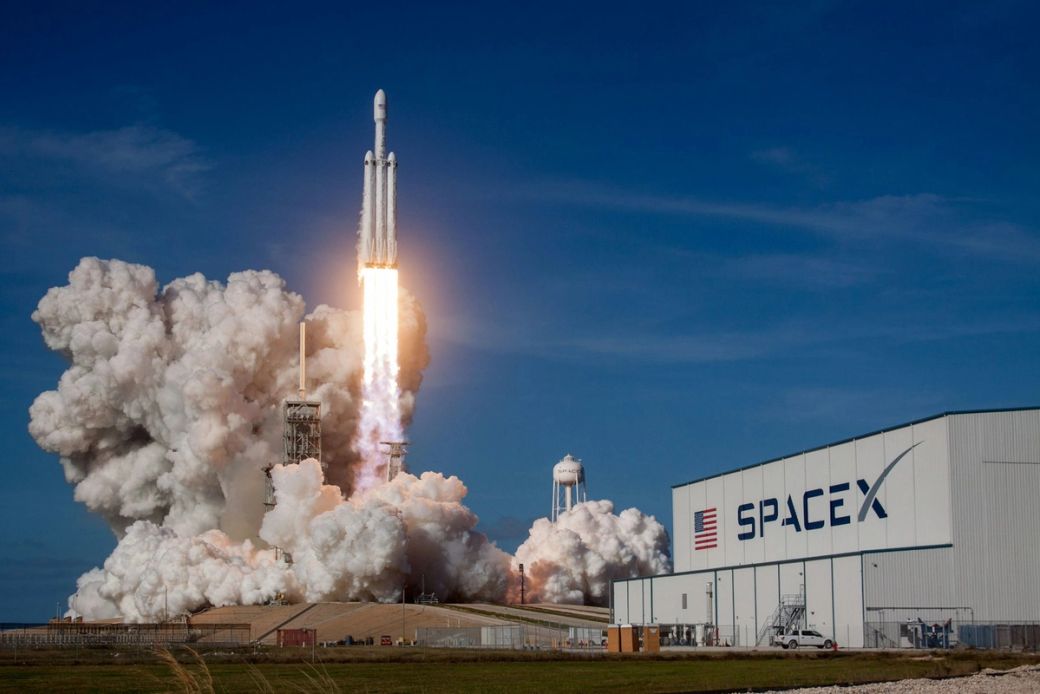
SpaceX's third-quarter results, released after the close on Tuesday, broke consensus models. Revenue came in at $14.58 billion, against Wall Street expectations of around $12.7 billion. Net income was $4.4 billion, or 35 cents a share, the company's first profitable quarter as a public company. Adjusted EBITDA of $8.81 billion was roughly a third ahead of estimates.
The shares jumped 9% in pre-market trading on Wednesday, to around $161, from a close of $147.79.
They were the headlines. The story underneath it is more complicated.
The bull case: demand is real, and the guide is enormous
The most important number in the release was not the third-quarter beat. It was the Q1 2027 revenue guidance of $33 to $37 billion. Consensus estimate for that quarter was $22.2 billion. That is not a small miss by analysts: it is a signal that SpaceX's AI compute business, which it calls Super Intelligence, is growing at a pace that existing models simply could not see.
SI revenue was $7.56 billion in the quarter, up from $813 million a year ago and ahead of the $6.47 billion consensus. It now represents 52% of total sales. Critically, the segment swung from a $1.26 billion operating loss in Q2 to a $431 million operating profit in Q3, which is the proof point the bulls had been asking for: that renting compute to AI customers can actually make money.
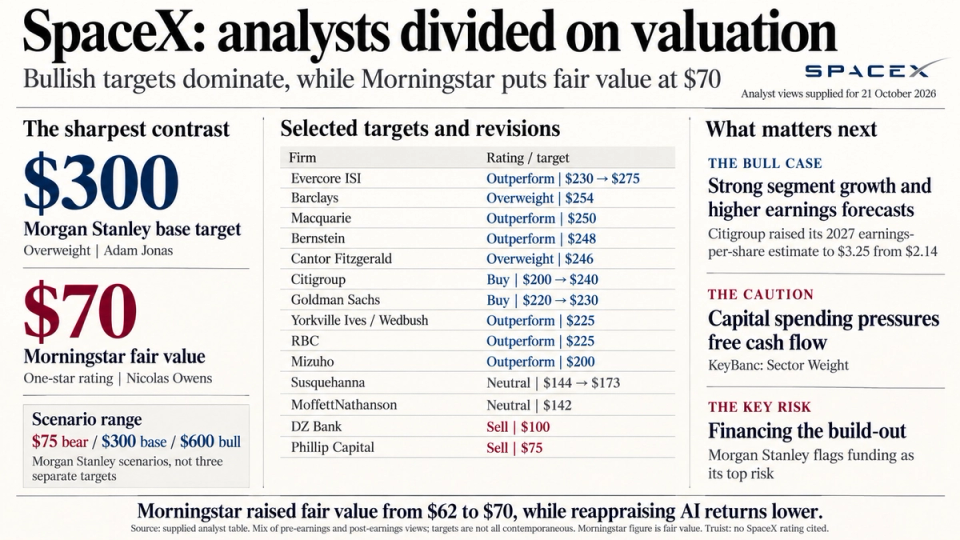
Truist said in a note after the earnings call that the results supported "continued pricing power and shorter payback periods" for AI cloud providers. Wedbush's Dan Ives, who has an Outperform rating and a $225 target, called the SI revenue growth of nearly triple the prior quarter's level a validation of the AI infrastructure thesis.
Starlink, the satellite connectivity business now has 13.6 million consumers, up from 7.2 million a year ago. Enterprise and government revenue grew 91% year on year to $2.13 billion. The segment produced $2.37 billion of operating income, the engine that funds everything else. More than 3,800 commercial aircraft are equipped with Starlink, with around 12,000 contracted. That pipeline is not going away.
And then there is Starship: Flight 14, on 28 September, was the vehicle's first revenue-generating mission. It deployed 26 Starlink satellites with roughly ten times the capacity of a Falcon 9 launch. Flight 15, expected in November, will attempt to catch both the booster and the ship simultaneously. Morgan Stanley's Adam Jonas has flagged a successful dual catch as the biggest single catalyst for the stock since the IPO.
The bear case: who pays for all this, and at what price?
SpaceX spent $19.6 billion on capital expenditure in Q3. It generated $8.81 billion of adjusted EBITDA. Free cash flow for the first nine months of the year was roughly minus $35 billion, and the company is guiding Q4 capex to $35 to $40 billion, nearly double the Q3 run-rate.
The balance sheet is not under stress. SpaceX had around $89.9 billion of cash and marketable securities at quarter-end against roughly $38.8 billion of debt. But the company is building its compute infrastructure with external capital, including a reported $40 billion financing package led by Apollo to buy Nvidia chips.
Morgan Stanley's Jonas, with a $300 price target, models debt issuance of $60 billion, $80 billion and $90 billion over the next three years. He calls financing "the biggest risk to our model." Credit markets noticed: SpaceX credit default swaps rose more than 7 basis points on results day to around 234 basis points.
The earnings quality question is also worth asking. The $4.4 billion net income exceeded operating income of $2.79 billion because of $1 billion of other income, including bitcoin-price recovery and related-party gains, $873 million of interest on the cash pile, and a $390 million tax benefit. Management guided Q4 gross margins back toward Q2 levels. The headline profit number looks better than the operating reality.
Several operational metrics also missed. Total launches were 35 against analyst expectations of around 41, and 44 in the same quarter a year ago. Mass to orbit was 476 tonnes, short of the roughly 559 tonnes expected. Nameplate compute capacity of 1.7 gigawatts was just under some estimates, and consumer
Read more
- 20/10/26SpaceX jumps after hours as AI revenue surges and profits smash estimates
- 09/08/26SpaceX is now an AI company with a rocket habit
- 11/04/26SpaceX spent more on capital expenditure last year than it brought in from customers. Now it wants a $2 trillion IPO.
Starlink subscribers of 13.6 million came in below the 14-plus million some previews had modelled. Consumer ARPU is also $69 against $83 a year ago, as cheaper international markets account for a growing share of the base.
The valuation argument
At around $160, SpaceX is trading at roughly 30 times expected 2027 adjusted EBITDA. Morningstar raised its fair value estimate to $70 after the results and still rates the stock one star, noting shares are trading at about twice its assessment of intrinsic value. Phillip Capital and DZ Bank both have Sell ratings with targets of $75 and $100 respectively. Citi, by contrast, raised its target to $240 and reiterated Buy.
The formal Q1 2027 guidance, annualised, implies roughly $132 to $148 billion of revenue. Elon Musk has talked about $500 billion to $1 trillion of annual recurring revenue by the end of next year. Investors should weight the formal guidance and the contractual backlog of $63 billion. The broader ambition is worth tracking, but it is not a number to put in a model.
There's one more technical factor in the 1.3 billion locked-up shares become eligible for sale two full trading days after the earnings print, with a further 328 million on 24 October. After SpaceX's Q2 results, the stock closed down 14% the following day before recovering. Whether history repeats will say as much about supply dynamics as it does about the fundamentals.
Where does that leave us?
If this quarter answered the question about AI demand. it did not tell us who ultimately funds the build-out, at what rate, and whether those returns are durable.
That said, the Q1 guidance was blow-out. The path from here runs through debt markets. The Starship Flight 15, and a margin recovery that management has, to its credit, flagged is unlikely to arrive in Q4.
For long-term holders, the story got meaningfully stronger on Tuesday night. For anyone buying at $160, the work is not done yet.