Ryan Cohen wants GameStop to run itself. GameStop's chief executive thinks AI will soon let the retailer operate autonomously, with software doing jobs the company used to pay outside suppliers for.
Email campaigns for trading card drops and midnight launches, which used to take weeks, now take 48 hours.
Cohen set out his thinking over lunch with analysts at Yorkville Ives, who see it as the start of GameStop's AI pivot.
The broker kept its outperform rating and $32 price target, about 25% above the current share price of $25.55.
Build, don't buy
Cohen thinks AI can fix or replace enterprise software and write the code that links it together.
That means the question is no longer which customer relationship management (CRM) system to buy, but whether to buy one at all.
He doesn't plan to spend money building AI models and will use existing ones instead.
So far the snags are hardware limits and the choice between running AI on the company's own machines or in the cloud, which he treats as minor.
He also argues that AI's mistakes do less damage than the human errors they replace.
Yorkville says this is the part of the story the market has not priced.
Cards on the table
The collectibles business is what makes the AI story possible, because it rebuilt the company's margins.
Collectibles sales grew 57% year on year in the second quarter and now make up 45% of revenue.
Video games are now less than 12% of revenue.
Cohen's view is that there's no money in consoles, and all the money is in footfall.
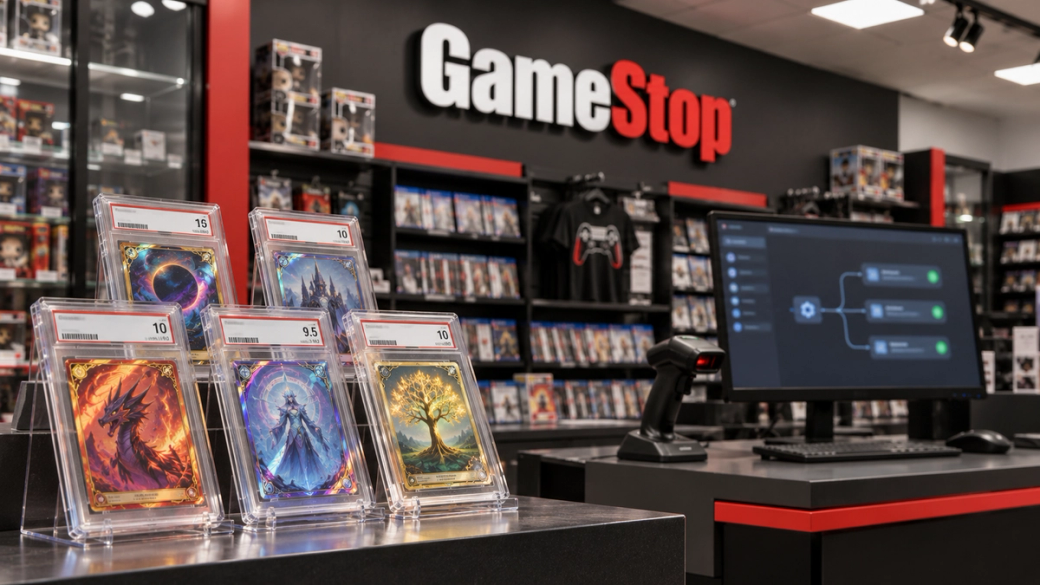
GameStop quickly became the biggest submitter of cards to PSA, the grading company, and roughly doubled PSA's business.
It buys back any card graded 8 or above at about 60% to 100% of market value, which turns its stores into a buying network.
Those cards feed Power Packs, a mystery box sold in store and through a digital vending machine, at higher margins than selling the same cards off the shelf.
Fewer, better stores
The store estate has shrunk from more than 7,000 worldwide at its peak to 1,600 in the US plus Australia, and every one makes a profit.
The customer has changed too, from bargain-hunting gamers to better-off collectors.
That's why Cohen wants more stores in prime locations, and the handful of new-format shops are paying back their costs in under a year.
Read more
- 15/07/26The AI bubble may be deflating. Wall Street is having its best quarter of the boom
- 01/07/26Wall Street is about to get its first real yardstick for the AI boom
- 20/05/26Goldman Sachs says AI stocks are behaving like defensive investments
Cash and eBay
GameStop ended the second quarter with about $5.1 billion of cash and securities, plus roughly $300 million of digital assets.
Against that sits $2.8 billion of convertible notes that pay no interest, so the cash earns about $200 million a year while the debt costs nothing.
The company has guided to adjusted earnings before interest, tax, depreciation and amortisation (EBITDA) of more than $650 million for the current financial year.
Yorkville's valuation also counts GameStop's stake in eBay. GameStop disclosed in July that it owns 43.4 million shares of eBay, nearly 10% of the company, after eBay rejected its roughly $56 billion takeover approach as "neither credible nor attractive".
Cohen has taken no pay since 2021 and says what drives him is growth in collectibles and profits, and AI.
He has been putting his own money in as well. A regulatory filing in October showed he had bought about $22.8 million of GameStop shares, taking his stake to 9.1%.
Not bad for a business that once billed itself, in Cohen's words, as the pawn shop of gaming.