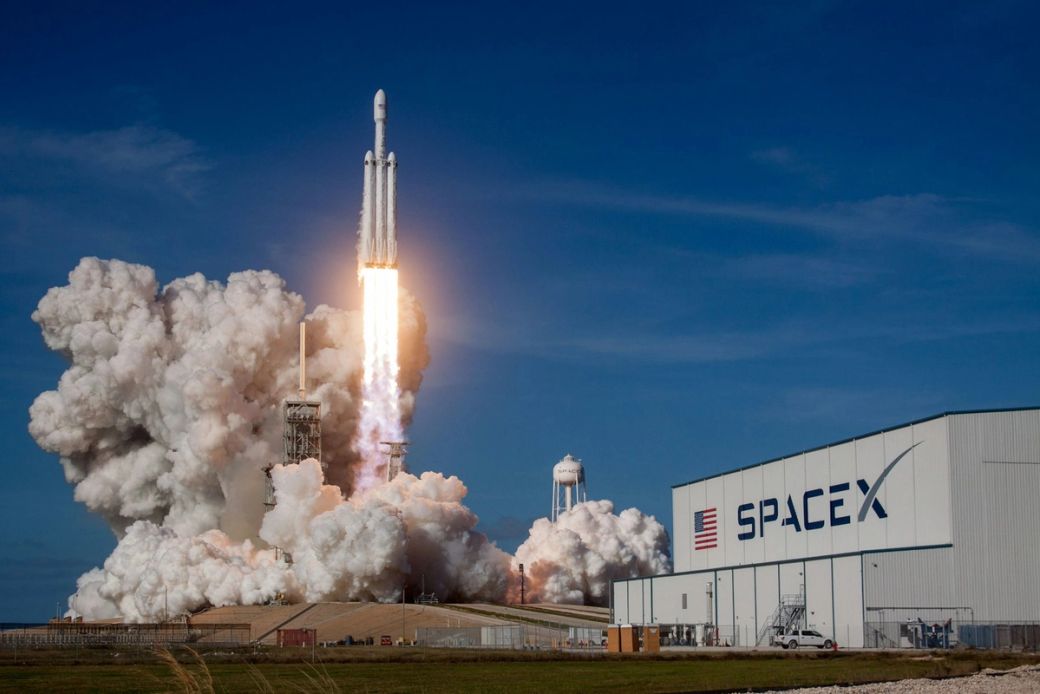
SpaceX begins trading on the Nasdaq today under the ticker SPCX, having priced its initial public offering at $135 per share last night for a market capitalisation of $1.77 trillion, the largest flotation in stock market history.
The $75 billion raise dwarfs the previous record set by Saudi Aramco in 2019, and the valuation means SpaceX arrives as one of the ten largest listed companies in the world, ranking alongside Aramco itself and comfortably above Tesla, which sits at around $1.6 trillion. Only Nvidia at $5.2 trillion, Alphabet at $4.6 trillion, Apple at $4.5 trillion, Microsoft at $3.1 trillion, Amazon at $2.9 trillion, and the largest chipmakers stand above it.
The market expects a premium open. Prediction market traders assign a 64.5% probability to shares opening between $150 and $200, implying a first-day gain of 11% to 48%, and the structural case for that premium is unusually strong.
Demand is the first driver. The book attracted more than $250 billion of investor interest against the $75 billion on offer, an oversubscription of roughly 3.5 to 4 times, with Goldman Sachs leading a syndicate of 21 banks alongside Morgan Stanley, Bank of America, Citigroup and JP Morgan. Retail investors have been allocated around 30% of the offering, roughly three times the norm for a mega-cap listing.
Scarcity an issue
The 555.6 million shares sold represent a free float of only around 4% to 5% of the company, and Elon Musk retains more than 82% of voting control. A thin float against heavy global demand is a classic recipe for a sharp opening move, and index funds become forced buyers almost immediately: MSCI has confirmed fast-track inclusion beginning tomorrow.
The third driver is momentum in the private marks. A tender offer in December 2025 valued SpaceX at roughly $800 billion, equivalent to $84 per share after the five-for-one stock split executed in May. The $135 IPO price represents a 61% premium to that level, meaning the valuation has more than doubled in six months, and demand at $135 suggests buyers believe the repricing has further to run.
Three parts
Underneath the mechanics sits a business of three very different parts, disclosed in detail for the first time in the S-1 prospectus filed on 20 May. Consolidated 2025 revenue was $18.7 billion, up 33% year-on-year, with adjusted EBITDA of $6.6 billion but a net loss of $4.9 billion.
Starlink, the satellite internet constellation, is the engine. The connectivity segment generated $11.4 billion of revenue in 2025, up roughly 50%, with $4.4 billion of operating profit and a 63% segment EBITDA margin. Subscribers doubled over the year to 10.3 million across 164 countries, served by more than 9,600 satellites. It is the only profitable segment in the group, and it is carrying the rest.
The launch business produced $4.1 billion of revenue but a $657 million operating loss, largely reflecting the more than $15 billion spent to date developing the Starship rocket. The AI segment, created when Musk folded xAI and the X platform into SpaceX in February at a combined valuation of $1.25 trillion, generated $3.2 billion of revenue against an operating loss of $6.4 billion in 2025, with losses deepening in the first quarter of 2026 as a full period of consolidation hit.
Heady multiple
At $135, investors are paying roughly 94 times 2025 revenue, a multiple without precedent among the world's largest companies, for a group whose accumulated deficit stands at $41.3 billion.
They are also setting the tone for what follows. SpaceX is the first of three AI flotations expected this year: Anthropic filed confidentially on 1 June following a funding round at a $965 billion valuation, and OpenAI filed a week later, last valued at $852 billion and targeting up to $1 trillion in a fourth-quarter listing. Together the pipeline is worth some $3.6 trillion, a concentration of blockbuster offerings not seen since the dot-com era.
How SPCX trades over the coming sessions will tell Anthropic and OpenAI exactly what the public market will pay for the AI story. A strong debut accelerates both; a stumble gives everyone pause.