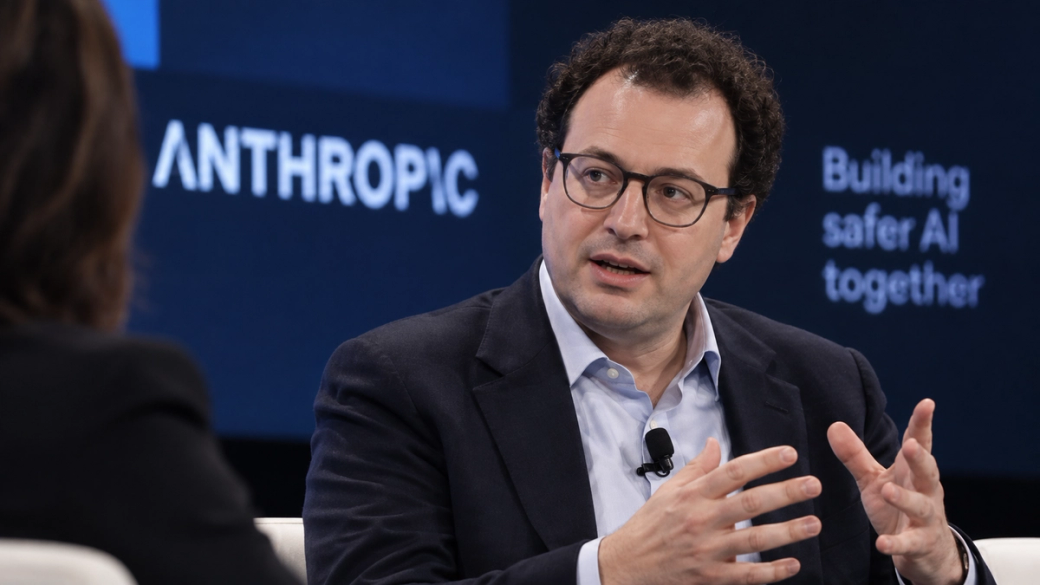
Dario Amodei, chief executive of Anthropic, has said he agrees with the researcher who resigned from his company this week over fears that artificial intelligence could wipe out humanity.
Speaking to CNN's Anderson Cooper on Saturday, Amodei said Jacob Coxon's departure was a criticism of the industry's pace rather than of Anthropic itself.
"I agree with Jacob much more than I disagree with him," he said.
X marks the spot
Coxon announced his resignation on X on Tuesday, writing that the people building AI believe it could kill everyone by the end of the decade and that this was no marketing stunt.
Amodei said Coxon had described Anthropic as the most responsible player in the sector on his way out, and that his complaint was aimed at an industry moving too fast.
The interview came hours after Amodei published a 3,800-word essay on his website arguing that the industry must slow the pace at which it improves AI models.
Anthropic, the San Francisco company behind the Claude chatbot, has committed to the first of three steps set out in the essay, titled We Must Pace the Frontier.
Safety measures
It will give third-party evaluators permanent, employee-level access to its systems so they can verify adherence to safety measures, report incidents and assess models during training.
Cooper asked what powers such observers would hold.
Amodei compared the arrangement to the supervisors that regulators embed in banks to check their practices, and said the same model could work in AI.
The second step involves pacing model releases among companies in democratic countries.
Amodei said that would require government involvement, because co-ordination between rivals on commercial activity raises antitrust and collusion concerns.
One-room solution
He asked the US government to convene the industry in one room and confirm the discussions amount to safety work rather than a cartel.
The third step extends the arrangement to a global standard.
Amodei conceded that each step is harder than the one before and said the plan may fail.
He said Sam Altman of OpenAI, Elon Musk and several legislators and government officials had voiced support within hours of the essay appearing.
Cooper asked Amodei whether he believed AI could kill all humans and what probability he attached to that outcome.
Amodei said he had used flat percentages in the past as a shorthand, but found them misleading because a figure such as 10% makes the outcome sound like a roll of the dice.
He said the risk becomes low if the industry takes the right paths and could exceed that figure if it takes the wrong ones.
The task, he said, is to focus on the industry's agency and its ability to choose between those paths.
Wrong people
Amodei warned against an excessive slowdown, saying it would hand the technology to the wrong people and raise the odds of things going wrong.
His essay acknowledged that humans may lose control of AI and that the technology could be misused for cyberattacks, bioterrorism and serious economic disruption.
Amodei has promoted the technology's advancement while facing accusations of doomerism over his warnings about its risks.
Coxon's resignation post drew more than 100 million views, according to Fortune.
The episode marks the first time a frontier AI developer has committed to permanent outside inspection of its own systems.
Amodei has a record of stark public warnings about the technology his company sells.
White collar wipe-out
In an earlier CNN interview he said AI could eliminate half of entry-level white-collar jobs and push unemployment as high as 20% within one to five years.
Jensen Huang, chief executive of chipmaker Nvidia, dismissed that claim at the time, saying Amodei thinks AI is scary but believes only his company should build it.
Whether rivals match Anthropic's inspection pledge will be the first test of the three-step plan.