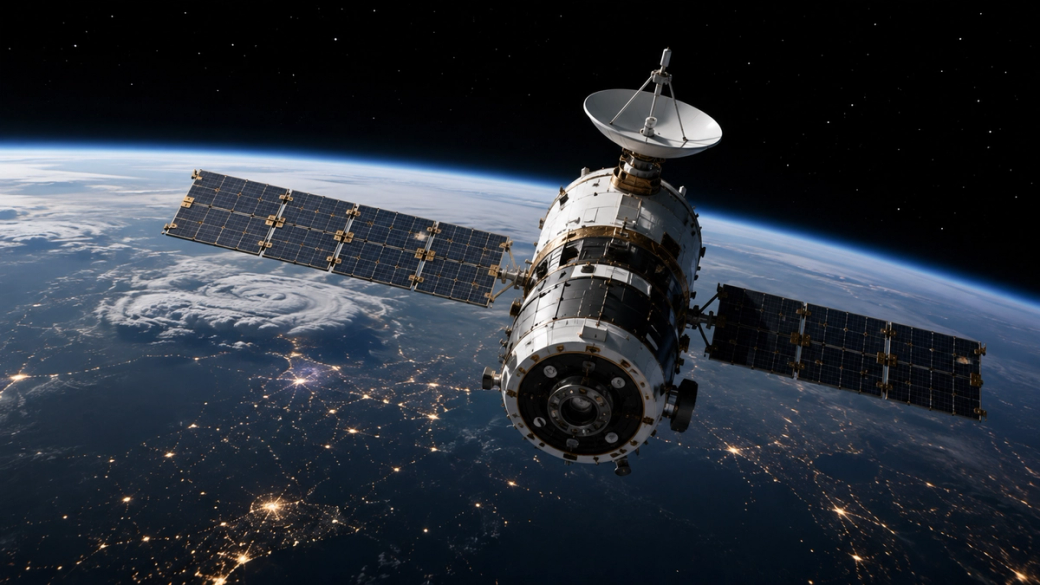
SpaceX wants to put a data centre in orbit. The timing, days before its IPO prices, is not a coincidence.
The AI1 satellite draws 120 kW, spans wider than a Boeing 747 and is designed to run AI workloads at 600 km altitude. SpaceX filed to launch a million of them. The announcement landed three days before the stock prices.
SpaceX unveiled AI1 in a 30-minute video posted to its X account on Monday, presenting a satellite designed to run AI workloads in orbit at roughly 600 kilometres altitude. The craft has a deployed wingspan of 70 metres, slightly exceeding a Boeing 747-8, and carries an average compute payload of 120 kW with a peak of 150 kW.
The company has filed with the FCC to launch up to a million orbital data centre satellites. It has signed compute deals including a $920m-per-month agreement with Google. The IPO is set to price on June 11 and begin trading on June 12.
A 30-minute product reveal three days before the biggest IPO in stock market history is not an engineering update. It is a prospectus supplement delivered by video.
What AI1 actually is
The satellite uses an interchangeable hardware bay that allows different chipmakers to supply processors rather than locking the platform to a single vendor. That design choice is commercially significant: it means SpaceX can accommodate customers running Nvidia, AMD, Google TPU or custom silicon without redesigning the satellite.
Musk compared the 120 kW average power draw to a single Nvidia GB300 rack, which gives a useful frame of reference. One satellite delivers the compute equivalent of one high-end server rack, but in orbit, where power comes from solar panels and cooling comes from radiating heat into space.
Thermal management is the engineering challenge. AI1 uses up to 110 square metres of deployable liquid radiators with redundant pumping loops and micrometeoroid shielding. The International Space Station's thermal system rejects about 70 kW across 422 square metres. AI1 is designed to reject more heat in roughly a quarter of the radiator area.
SemiAnalysis estimated the ISS thermal system cost up to $500m. SpaceX's approach, if it scales, would need to deliver the same function at a fraction of that cost across potentially millions of units.
Musk told SpaceNews it is "safe to say SpaceX knows how to do heat rejection in space."
IPO narrative
SpaceX's S-1 lays out a $28.5 trillion total addressable market, with $26.5 trillion attributed to AI. The AI1 reveal converts that TAM slide into hardware. Investors pricing the IPO on Wednesday are being shown, in concrete terms, what their money would fund.
The $920m monthly Google deal provides anchor revenue. The FCC filing for a million satellites provides scale ambition. The interchangeable hardware bay provides customer optionality. Every element of the announcement is designed to answer a specific investor question.
Unanswered questions
A million satellites at 600 km altitude would create an orbital environment fundamentally different from today's. The debris risk, spectrum management, regulatory approvals and manufacturing scale required to produce satellites at that volume are all unsolved problems.
The power density is impressive. The thermal engineering is credible. The timeline for deploying even a fraction of the filed constellation is measured in decades.
SpaceX is selling the future three days before it asks the public to buy shares in it. The satellite is real. The scale is aspirational. The timing is pure theatre.