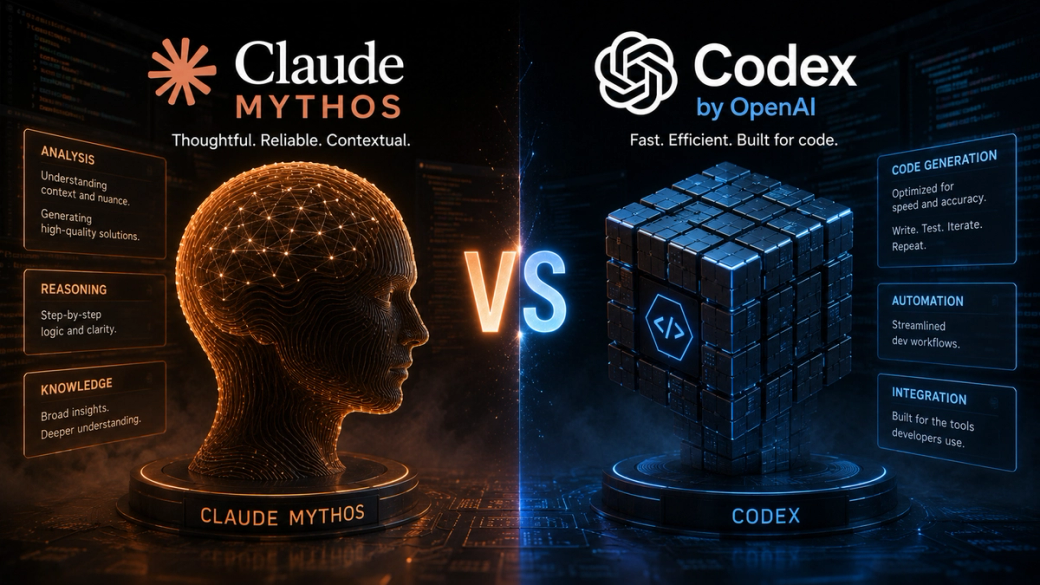
The frontier of AI agents is shifting from solving problems to identifying which problems are worth solving, and a new head-to-head experiment suggests the leading models diverge sharply on that skill.
Nate B Jones, a widely followed AI commentator and practitioner, set OpenAI's Codex and Anthropic's Fable an unusual challenge: rather than handing each a task, he gave both agents free rein over his local files and Slack communications and asked them to define the problem themselves, propose a solution, and build the automation.
The premise is that people describe their business problems differently from what their behaviour actually reveals, and the biggest pain points are often hidden messes in workflows that neither leaders nor contributors can see.
The two agents returned strikingly different answers.
Strategy versus execution
Fable, in Jones's account, was a hassle to operate, throwing up repeated permission dialogs that slowed the process.
But it produced what he called a significantly better and more interesting problem than expected, demonstrating genuine strategic insight by recognising that the central challenge in his content business is choosing the right story among countless AI-generated candidates.
Its proposed "pre-pipelining" tool, designed to refine ideas and make selection easier, struck Jones as having strong leverage potential, even if the final solution defined the problem too narrowly to be fully useful.
Codex behaved differently.
Given a completely free hand and operating in ultra mode with enormous token budgets, it selected a bounded, manageable task: improving a handoff package so scripting could begin faster.
Jones argues this is characteristic, since Codex consistently picks problems that are relatively easy for it to handle rather than the most painful issues facing a business.
The tool it built worked first time, but the problem it chose was not the one that mattered.
His verdict split accordingly: Fable for strategic problem discovery, whose output can then be handed to cheaper execution tools, and Codex as the dependable everyday harness that is fast, frugal with tokens and free of pop-ups.
The scale context
The comparison lands amid a striking adoption gap.
Jones notes that ChatGPT and Codex together have been adding roughly one million users per day over the past week, with a combined base now exceeding Claude Code.
That makes Codex's conservatism consequential: the most widely used agent is the one least inclined to hunt for the hardest problems.
Jones has packaged the experiment as a reusable skill, allowing users to instruct an agent to audit their own workflows, with safeguards such as excluded Slack channels, and return a tailored automation.
The broader lesson is that the "open claw" problem, owning powerful AI without knowing how to extract value from it, may itself be solvable by AI, provided users pick the right agent for the right half of the job.