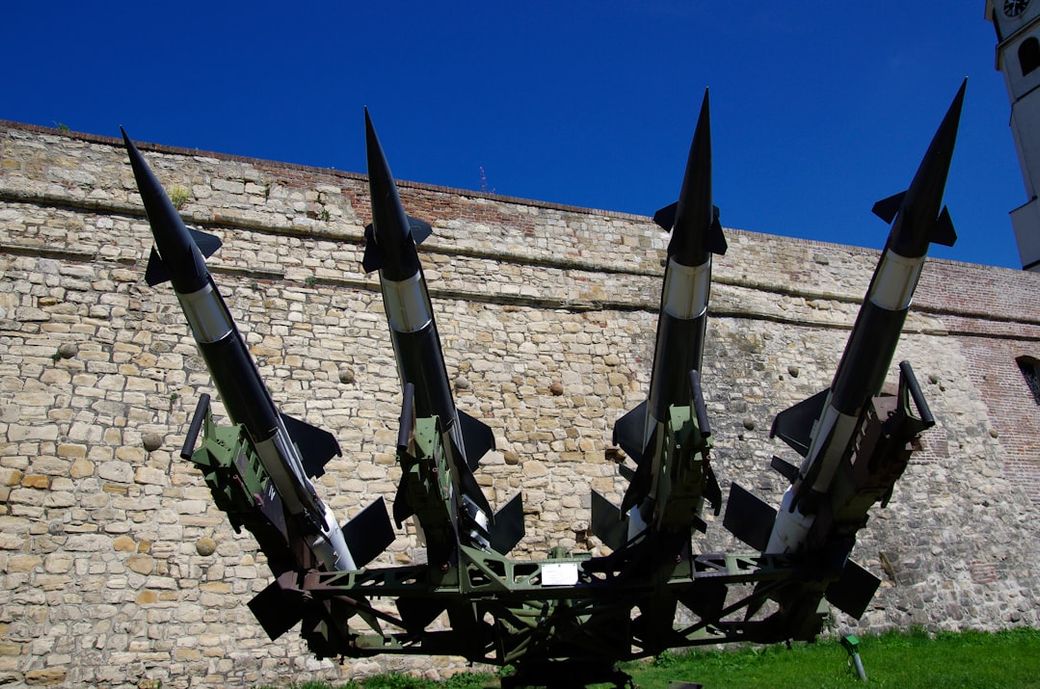
You have probably read that the world is in an artificial intelligence arms race.
A former DeepMind executive, writing in Wired, argues that this framing is not just inaccurate but actively harmful.
Here is the argument, in plain terms.
What an "arms race" implies
Calling something an arms race borrows its meaning from the Cold War, when the United States and the Soviet Union competed to build ever more nuclear weapons.
The phrase suggests a two-way sprint with a finish line, where falling behind is dangerous and getting there first is everything.
Applied to AI, it casts the United States and China as rivals in a contest where the winner takes a decisive strategic prize.
The critics' point is that this picture does not actually fit how AI works, and that believing it changes behaviour for the worse.
Why the metaphor may not fit
The first problem is that there is no finish line.
Unlike a race, AI development is a continuous process with no single moment of victory, so the idea of "winning" is misleading.
The second problem is that AI knowledge spreads easily.
Ideas and techniques are quickly copied, reverse-engineered and distilled by competitors, so racing ahead often helps rivals catch up rather than leaving them behind.
That is close to the opposite of a nuclear stockpile, which stays secret and gives lasting advantage.
How the framing can increase risk
The deeper worry is that the language becomes self-fulfilling.
If everyone believes they are in a race, the rational move is to go as fast as possible, because slowing down means losing.
Speed, however, is exactly what makes powerful technology unsafe, leaving less time to test systems and build in safeguards.
So a metaphor meant to describe the situation ends up shaping it, pushing companies and governments to cut corners on safety in the name of not falling behind.
The framing also affects policy.
Politicians frequently invoke the race with China to argue against regulating AI at home, on the grounds that rules would hand the advantage to a rival.
That turns the metaphor into a reason to do less about the technology's risks, not more.
What critics want instead
The argument is not that competition between countries and companies is imaginary.
It is that describing it as an arms race hides other options.
Once you drop the assumption of a single winner-takes-all sprint, possibilities like shared safety standards, agreed limits on military uses of AI and international cooperation start to look realistic rather than naive.
Those tools simply do not fit inside a story where the only question is who crosses the line first.
Why it matters
The underlying claim is that words are not neutral.
The way journalists, politicians and industry describe AI helps decide how it is built and governed.
If the dominant story is a dangerous race, the critics say, we may talk ourselves into exactly the reckless behaviour we should be trying to avoid.
Their suggestion is modest but pointed: choose the metaphor carefully, because in this case it may help determine the outcome.