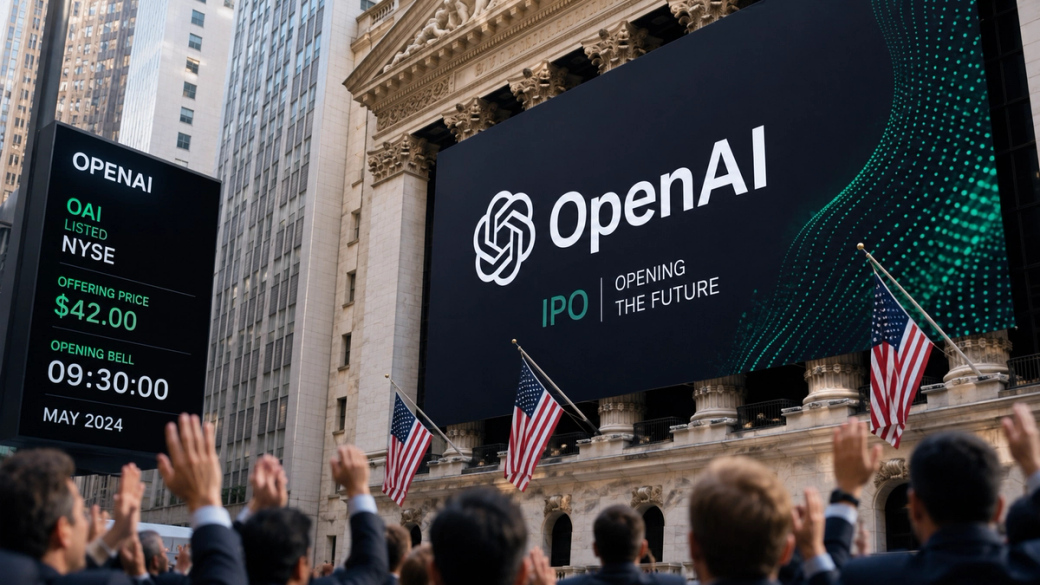
OpenAI is considering postponing its initial public offering until 2027, according to multiple reports citing people involved in the company's internal deliberations. The shift represents a reversal from the late-2026 timeline the company had been signalling since January. Sam Altman has told advisers that any reduction to a $1 trillion valuation is a "non-starter."
The timing is not accidental. It follows SpaceX's difficult IPO debut in June. Elon Musk's company raised $85 billion at a $2.77 trillion valuation but has since fallen from a peak of $225 to $153 per share. The decline has made OpenAI's advisers cautious about market receptivity to mega-scale AI listings.
Advisers presented Altman with a binary choice: wait until 2027 and pursue the $1 trillion target, or accept a lower valuation for a faster late-2026 listing. Altman chose to wait. The decision was presented as a strategy question. It was actually a capitulation.
Vacuum fills immediately
Anthropic filed a confidential S-1 on June 1, a week before OpenAI filed on June 8. The company is targeting an October 2026 debut at a $965 billion valuation with Goldman Sachs, JPMorgan and Morgan Stanley as lead underwriters. Anthropic hired Wilson Sonsini months earlier specifically to outpace OpenAI's listing path.
The prediction markets have already rendered a verdict. Polymarket traders assign a 73-75% probability that Anthropic will IPO first. Traders price the odds of an OpenAI IPO by December 31, 2026 at approximately 54%, down sharply from earlier expectations. The market is saying Anthropic wins and OpenAI loses.
More importantly, traders are pricing Anthropic's competitive advantage. Anthropic is assigned a 94% probability of being worth more than OpenAI by the end of 2026. The markets that were structured as neutral between two giants now show one company as dominant.
Structural advantage
Anthropic's position strengthens on multiple fronts. First, filing earlier creates momentum. Bankers told both companies that whoever lists first will define the new industry. Anthropic gets to set the valuation bar. OpenAI will be forced to either meet or exceed it.
Second, Anthropic avoided the regulatory landmine that OpenAI is now facing. The Trump White House asked OpenAI on June 25 to stagger the release of GPT-5.6 to a small group of government-approved customers before any broader rollout. That request is an operational constraint that will slow OpenAI's deployment and complicate its IPO narrative around unrestricted model capability.
Third, Anthropic is generating real cash. The company has $47 billion in annualised revenue run rate and is projected to break even by 2028. OpenAI has a projected 2028 loss of $74 billion. That gap matters to IPO investors.
Collateral damage
SoftBank, which holds a $65 billion stake in OpenAI, saw its stock plummet 12.5% when the IPO delay became public. The company had been counting on a 2026 exit to address cash flow pressures and ongoing losses from its AI and robotics bets.
The market is punishing patience. Companies that delay IPOs to preserve valuation often lose the window entirely. Market sentiment shifts. Regulatory environment changes. Competitive positions erode. OpenAI's decision to wait until 2027 may look prudent by 2026 standards. It may also look stubborn by 2027 standards.
The resolution
This was bound to happen given the extremely difficult SpaceX IPO, Anthropic's coordinated filing strategy and the crowded 2026 IPO calendar. Three trillion-dollar listings in short order was always unsustainable. One company had to fold. OpenAI folded.
Anthropic is now in control of the narrative. The company will list first. It will define what a trillion-dollar AI company looks like in public markets. By the time OpenAI comes to market in 2027, the valuation will be either validated or discredited. Either way, OpenAI will follow rather than lead.
The market has already priced that outcome