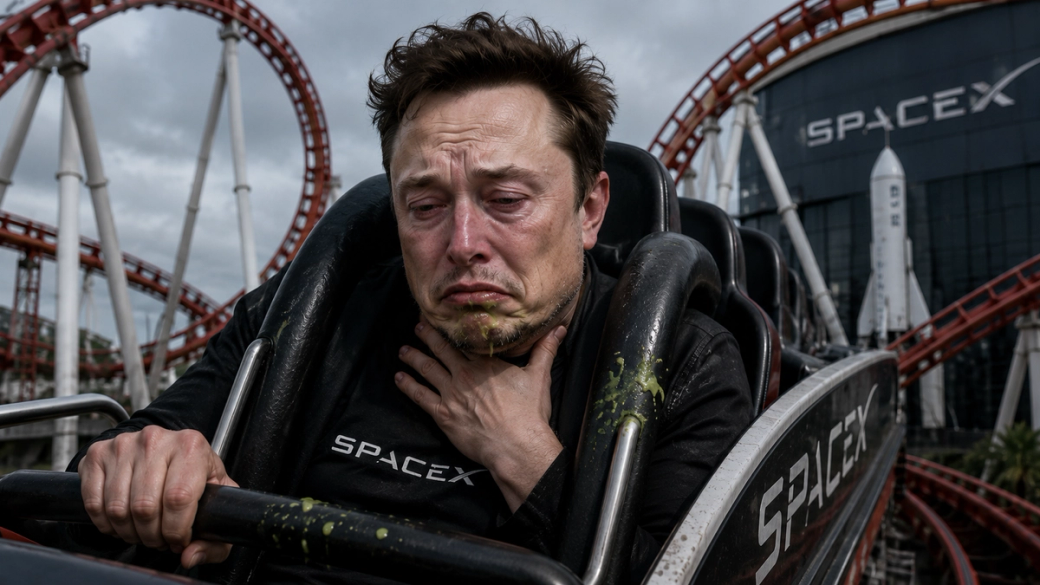
On June 12, SpaceX priced at $135 per share for a $1.77 trillion valuation and opened at $150. The math was immediate: Elon Musk's net worth crossed $1 trillion. He became the world's first trillionaire. History was made. The narrative was written. Champagne was flowing at SpaceX headquarters in Starbase, Texas.
By June 19, the stock had surrendered most of those gains. It closed at $153 after a 16.4% single-day selloff that capped a three-day losing streak. Musk's fortune contracted by $250 billion in a week.
This is not a story about a company that got cheaper. This is a story about what happens when retail hysteria meets institutional reality and loses.
The math at the peak
At $225 per share, SpaceX's market cap topped $3 trillion on paper. The company briefly became the fourth-most-valuable public company in America, ahead of Amazon and Microsoft. Musk's stake alone was worth more than the entire market cap of Tesla. He could have bought every automaker in the United States, Europe and Japan and still had $600 billion left.
That lasted three trading days.
The IPO was supposed to be different. This was not some overhyped software startup or fintech darling. This was SpaceX: the company that landed rockets vertically, built Starlink, and dominated commercial spaceflight. Elon Musk built it. Musk companies have a history of printing money. The hype was justified, the believers said.
Retail investors were believers. Vanda Research found net buying of $405 million in the first five trading sessions. Gil Luria at D.A. Davidson summed the dynamic: "Elon Musk companies don't really do that." Except this time they did. Until they didn't.
The fundamentals question
The company reported $18.7 billion in revenue for 2025. It also reported a $4.9 billion net loss. The Q1 2026 loss was $4.28 billion. The pattern is clear: SpaceX is spending money faster than it earns it.
Morningstar analyst Nicholas Owens looked at the IPO valuation and reached a conclusion that the market has now mostly agreed with: SpaceX is worth about $780 billion, not $1.77 trillion. The company is overvalued by 55% even at the current depressed price. By revenue, SpaceX is the 200th largest company in America. By market cap, it is the ninth. That gap is where risk lives.
Musk promised $1 trillion in revenue by 2030. The street is pricing in that those promised revenues will materialise at AI-driven margins that may not. It is pricing in orbital data centers that do not exist yet and may never exist. It is pricing in Elon Musk's visionary ability to compress 10 years of growth into four.
That is a tall order for a company losing $4 billion per quarter.
What the week actually revealed
Three things became clear between June 12 and June 19. First, the retail buying power that lifted the stock has limits. Institutional investors hold different views about valuation and risk. Second, the architecture of SpaceX's lockup period is creating a monetization timeline that is already being priced in. Insiders can sell 20% of their holdings after Q2 earnings in early August. Another 10% can move if the stock stays up 30% for five trading days. That's three weeks and two conditions away from material share supply hitting the market.
Third, Musk's paper wealth is fragile. A $250 billion move in a week is not because the company fundamentally changed. It is because the market's mood shifted from euphoria to sobriety. The bigger the rally, the harder the crash. This week demonstrated that SpaceX is subject to the same rules as every other IPO: a price is what people will pay. And people will not pay $225 for a company losing $4 billion per quarter with a valuation that assumes everything goes right.
Musk is still a trillionaire. On paper. For now. The liquidity problem is just beginning.