TLDR
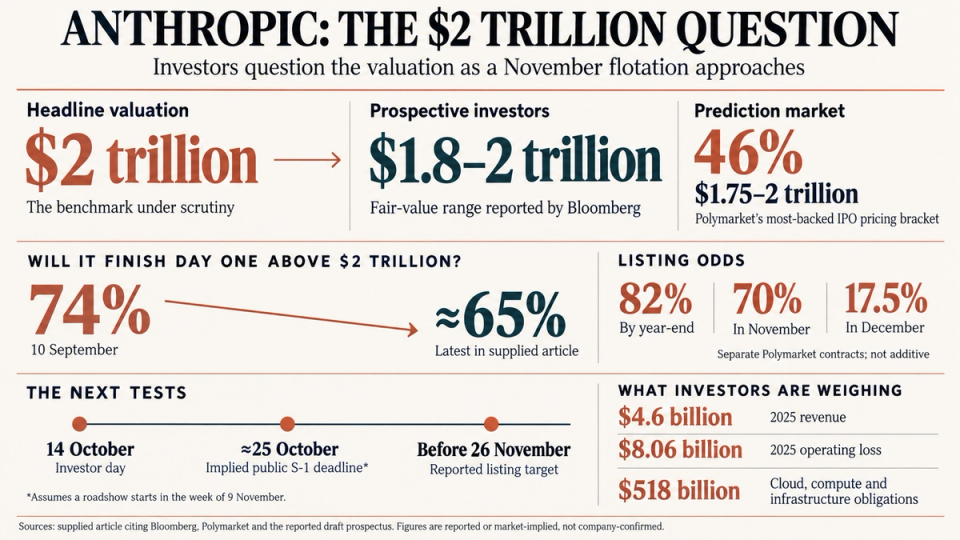
- Bloomberg reported on Thursday that prospective investors see fair value at $1.8 trillion to $2 trillion, the first reported pushback below the $2 trillion headline.
- Polymarket got there first: its most-backed IPO price bracket is $1.75 trillion to $2 trillion at 46%, and the odds of a first-day close above $2 trillion have fallen from 74% to about 65% since 10 September.
- A listing before Thanksgiving requires a public S-1 by about 25 October, so the 14 October investor day and the third-quarter numbers will carry the argument.
- Polymarket gives 82% to a listing by year-end and 70% to November, with December at 17.5%.
The question over Anthropic's flotation has changed: no longer whether it lists this year, which the markets have largely settled, but whether the price keeps a 2 in front of it.
Bloomberg reported on Thursday that some prospective investors put fair value at $1.8 trillion to $2 trillion, the first reported pushback against a headline figure that has stood since August.
Until this week the number had only moved up.
It was $965 billion at May's funding round, at least $2 trillion by August and more than $2 trillion in the draft prospectus leaked to Reuters on 28 September.
Prediction market prices changing
Prediction markets had priced the softening before the newswires caught up with it.
Polymarket's market on the valuation at the IPO price puts 46% on a $1.75 trillion to $2 trillion bracket, its most-backed outcome.
Its separate market on the first-day closing market capitalisation centres on $2 trillion to $2.25 trillion, at 28.5%.
Read together, traders expect Anthropic to price below $2 trillion and trade modestly above it on day one, which is almost exactly the range Bloomberg's sources describe.
The probability of a first-day close above $2 trillion has fallen from 74% on 10 September to about 65% now.
The timetable gives the company three weeks to turn that around.
Bloomberg's reporting has formal marketing starting as soon as the week of 9 November and the shares trading before Thanksgiving on 26 November.
Timeline
Securities and Exchange Commission rules require the prospectus to be public at least 15 days before a roadshow begins, which means the S-1 registration statement, the public version of the prospectus, must be filed by about 25 October.
That filing would be the first step confirmed by the company or a regulator since the confidential submission on 1 June.
No bank, exchange, date, size, price range or ticker has been confirmed by either.
The investor day at Anthropic's San Francisco headquarters on 14 October therefore lands before the filing, and it is the first chance to put third-quarter numbers in front of the people quoting $1.8 trillion.
Why the number is softening
The reason sits in the draft prospectus itself.
It shows 2025 revenue of nearly $4.6 billion, roughly 12 times the 2024 figure, against a net loss of about $42 billion.
Some $34 billion of that is a non-cash charge on the fair value of financing that may convert into shares.
Strip it out and the operating loss still widened to $8.06 billion from $2.98 billion.
Spending on compute and infrastructure tripled to $7.33 billion, and beyond that sit $518 billion of cloud, compute and infrastructure obligations, most of them non-cancellable.
Cash, equivalents and short-term investments stood at $20.28 billion at the end of 2025.
Two customers supplied nearly a quarter of last year's revenue, about 12% each, and many of the largest customers are not on long-term contracts.
About 80 of the draft's 261 pages are given over to risk factors, against 48 on the business, including a warning of catastrophic or existential risk to humanity.
Governance adds friction of its own
The seven co-founders direct a single Class F share, through a vehicle called Founder LLC, that carries 50.1% of the vote on most matters.
The Class F share falls away once two or fewer founders remain. It sits within a five-class structure: the public buys Class A stock at one vote a share, while strategic partners, where Amazon and Google sit, get minimal votes.
The partners with the fewest votes are also the ones whose cloud marketplaces carried 47% of last year's revenue, on PitchBook's reading of the draft.
Anyone paying close to $2 trillion is buying into a company whose founders can outvote them on most questions.
What the third quarter has to prove
The Wall Street Journal reported that the slip from October to November was made so that third-quarter results could be shown to investors.
Anthropic has told a small group of shareholders to expect a second consecutive quarter of adjusted operating profit, with gross margins above 80% before partner revenue-sharing and model-training costs.
The draft does not itself disclose a gross margin, which leaves that 80% resting on what shareholders were told rather than what the filing shows.
The quarter will also settle a comparison with OpenAI, whose annualised run-rate reached almost $70 billion by late September against Anthropic's roughly $65 billion in July.
OpenAI has ruled out listing in 2026, and Polymarket puts Anthropic first at 97%.
The deal is expected to raise up to $100 billion, with Nvidia in talks to anchor up to $10 billion, matching or exceeding the $86 billion SpaceX raised in June.
Even a pricing below $2 trillion would value Anthropic above SpaceX, which listed at about $1.77 trillion.
The odds on another slip
Polymarket gives 82% to an Anthropic listing by 31 December and 70% to November as the month, with December at 17.5% and February 2027 at 4.5%.
Kalshi resolves on a formal confirmation rather than the listing itself: an effective S-1, a priced deal or an assigned ticker.
It has 76% on that happening before 1 December, up from 54% on Tuesday, before Bloomberg's Thanksgiving report.
Its year-end rung has drifted to 78% from 97% in August.
It touched 67% in the week of 21 September after the Journal's delay story, before the Reuters leak pulled it back.
Timing has already slipped twice: from October to just before the 3 November midterm elections, then to just after them, and now to mid-November.
Polymarket's month market favoured October until the Journal's report and flipped to November within days.
The two venues disagree on who runs the deal: Polymarket has Morgan Stanley as lead bank at 84%, while Kalshi last favoured Goldman Sachs at 61%.
Each delay has bought time to add numbers to the case, and the range investors are now quoting suggests the case is not yet closed.
The price range, which arrives shortly before marketing begins, will show whether $2 trillion survived contact with the people being asked to pay it.