Microsoft's Majorana 2 cuts its quantum timeline to 2029. The evidence has not caught up
The new chip claims qubits 1,000 times more reliable, built with AI and a switch to lead. The breakthrough sits in a preprint physicists are already picking apart.
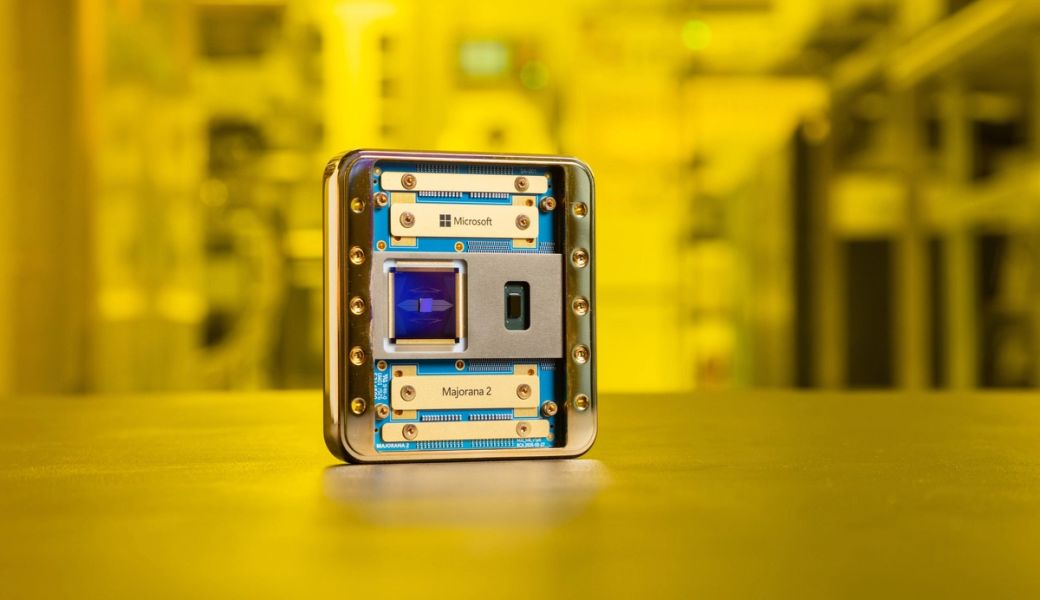
Microsoft has a pattern with quantum computing. It makes a striking claim, attaches enormous numbers to it, and leaves the proof for later. Majorana 2, the chip it unveiled at its Build conference this month, fits the pattern. The claim is now bigger, and the evidence is still a preprint.
What Majorana 2 claims
The headline figure is reliability. Microsoft says Majorana 2 is 1,000 times more reliable than Majorana 1, the chip it announced in February 2025. It puts the mean lifetime of a qubit at about 20 seconds, with some reaching a minute, against five to 10 seconds for the earlier chip.
The gain comes from a change of materials. Microsoft replaced the aluminum superconductor in Majorana 1 with lead, and reworked the semiconductor layer. Lead, the team says, shields the fragile qubits from the stray disturbances that wreck quantum states.
The company also leaned on its own AI. Engineers used Microsoft Discovery, an agentic research tool now on general release, to automate measurements and hunt for flaws in the design. On the strength of the results, Microsoft halved its timeline and now aims for a scalable, practical quantum computer by 2029.
Why it would matter
If the physics holds, this is the hard problem in quantum computing solved. Most qubits are fragile and lose their state in fractions of a second. Machines burn vast resources correcting the resulting errors, which is the main barrier to a large, useful quantum computer.
Topological qubits, Microsoft's approach, would store information in the structure of the system rather than a single delicate state. A qubit that survives for 20 seconds rather than microseconds needs far less correction. That is what would carry quantum computing from physics demos toward real machines that could model molecules, design batteries and crack problems in chemistry and medicine.
The same evidence problem
The catch has not changed since Majorana 1. The new claim sits in a preprint that has not been peer-reviewed. It builds on earlier results the physics community never accepted, including a Nature paper whose own editors said it did not show topological behavior.
Outside researchers have been blunt. Sergey Frolov, a quantum physicist at the University of Pittsburgh, said the preprint rests on a track record too weak to count as a foundation. Scientific American reported a hostile reception from physicists, some of whom doubt the device works at all. Henry Legg, who challenged Microsoft's testing method last year, remains a critic.
Microsoft is unmoved. Executive Jason Zander compared the work to inventing the transistor, arguing the team had to prove the underlying physics was real first. The company says decisive data is coming and points to its place in the final phase of a DARPA quantum benchmarking program.
What it means for Microsoft
For investors the question is narrower. Quantum is option value for Microsoft. It is a small, speculative line against the scale of Azure and AI, with a large return if the science holds. Wedbush called Majorana 2 another validation for the sector, language that says more about momentum than proof.
The market is real even if any single chip is not. Analysts expect quantum computing revenue to grow from about $3.5 billion in 2025 toward $20 billion by 2030. Microsoft is not alone in chasing it. IBM is targeting 2029 as well, and Amazon has pushed its own error-resistant chip, Ocelot.
What separates a headline from a turning point is reproducibility. Peer review, independent labs rebuilding the device, and the DARPA evaluation will decide whether Majorana 2 is hardware or marketing.
Microsoft has now made its boldest quantum claim on its fastest timeline. The numbers are larger, the roadmap shorter, the AI angle new. The thing that would make Majorana 2 a breakthrough, evidence others can check and repeat, is the one thing still missing.