Meta Platforms, the owner of Facebook, Instagram and WhatsApp, has its first genuine consumer artificial intelligence (AI) hit in Muse, and the debate has already shifted from how fast it is growing to whether it can ever make money.
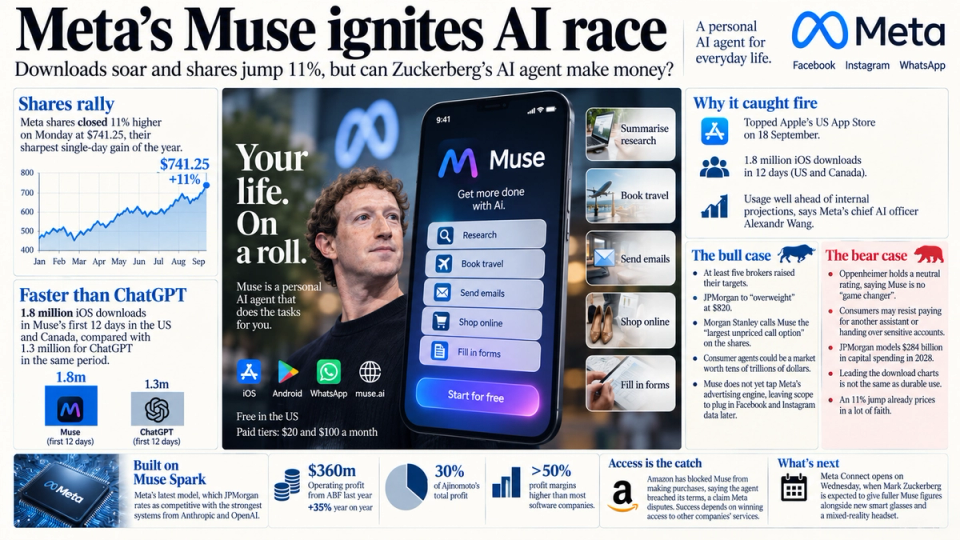
The shares closed 11% higher on Monday at $741.25, their sharpest single-day gain of the year and part of what looks set to be Meta's best month in more than a decade.
The trigger was third-party data showing Muse signing up users faster than OpenAI's ChatGPT did at the same point in its launch, backed by a wave of broker upgrades.
What Muse actually does
Muse is a personal AI agent, meaning it is built to complete tasks rather than simply answer questions, from research and form-filling to sending emails, booking travel and online shopping.
Some jobs keep running after the app is closed, and the product is free in the US across iOS, Android, WhatsApp and the muse.ai website, with paid tiers at $20 and $100 a month.
It runs on Meta's Muse Spark model, the newest version of which JPMorgan rates as competitive with the strongest systems from Anthropic and OpenAI.
Why did the app catch fire?
Apptopia, an app analytics firm, estimated 1.8 million iOS downloads across the US and Canada in Muse's first 12 days, against 1.3 million for ChatGPT over a comparable stretch.
The agent topped Apple's US App Store on 18 September, and Meta's chief AI officer, Alexandr Wang, said usage had already run well ahead of internal projections.
The bull case
At least five brokers raised their targets, with JPMorgan lifting the stock to "overweight" at $820 and Morgan Stanley describing Muse as the "largest unpriced call option" on the shares.
Morgan Stanley sized the potential market for consumer agents in the tens of trillions of dollars, and pointed out that Muse does not yet feed Meta's advertising engine, leaving scope to plug in Facebook and Instagram data later.
Bear case
Oppenheimer was not persuaded, holding a neutral rating and arguing that Muse is no "game changer" while consumers may resist paying for yet another assistant, or handing an agent the keys to sensitive accounts.
The sheer cost of the strategy is the other concern, with JPMorgan modelling Meta capital spending of $284 billion in 2028 as it races to build AI infrastructure.
Some analysts also caution that leading the download charts is not the same as durable use, and that an 11% jump already prices in a lot of faith.
Catch for every agent
Muse only pays off if it can reach other companies' services, and Amazon has already blocked it from making purchases, saying the agent breached its terms, a claim Meta disputes.
Attention now turns to Meta Connect, the company's annual product event, which opens on Wednesday when chief executive Mark Zuckerberg is expected to give fuller Muse figures alongside new smart glasses and a mixed-reality headset.